
Convenience Store Insurance FAQ:
18 Questions Store Owners Actually Ask
Convenience stores typically carry general liability (averaging $72/month per Insureon's 2026 data), commercial property or a business owner's policy ($184/month average), workers' compensation ($82/month average), and crime coverage — with liquor liability, pollution/UST coverage, and equipment breakdown added by product mix. These 18 answers cover coverage, cost, state requirements, claims, and the exposures unique to stores selling alcohol, fuel, or operating around the clock.
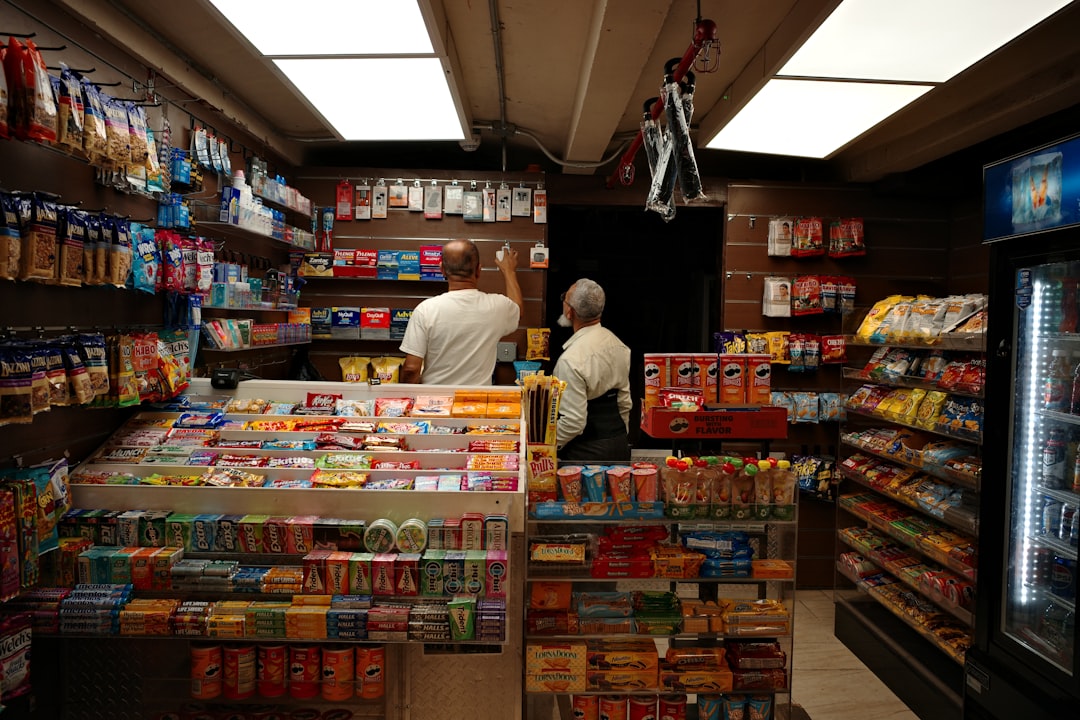 Photo by Permadi Creative
on Unsplash
Photo by Permadi Creative
on Unsplash
- 2026 benchmarks (Insureon): general liability $72/month ($857/year), business owner's policy $184/month ($2,208/year), workers' comp $82/month for convenience stores vs. $175/month for grocers.
- Your product mix sets your program: alcohol triggers dram shop exposure (most states impose it; Illinois requires proof of liquor liability insurance for on-premise and combined-consumption licenses), and fuel triggers EPA underground storage tank (UST) financial responsibility — $1M per occurrence for petroleum marketers.
- Crime is the underweighted line: convenience store workers face one of the highest work-related homicide rates of any industry (NIOSH/CDC), and crime policies split limits between money vs. stock with strict conditions.
- Spoilage sublimits are commonly $10K–$25K with 12–24 hour waiting periods — often mismatched against FoodSafety.gov's 4-hour refrigerated / 48-hour freezer safety windows.
- The five most common denial traps: the GL liquor exclusion, the pollution/UST exclusion, unmet crime-policy conditions, protective-safeguard endorsements, and late notice.
What coverage does a convenience store actually need?
A convenience store's core program combines general liability, commercial property (usually bundled as a business owner's policy), workers' compensation, and crime coverage — then adds liquor liability, UST/pollution coverage, and equipment breakdown based on what the store sells. The full program design is in our convenience store insurance guide, and the convenience store industry page covers how we place these accounts.
Every convenience store needs general liability for customer injury claims, commercial property for the building, coolers, and stock, workers' compensation once state thresholds are met, and crime coverage for robbery and employee dishonesty. Stores selling alcohol add liquor liability; stores selling fuel add UST financial responsibility coverage; most stores benefit from equipment breakdown and spoilage endorsements for refrigeration.
The right program tracks the product mix — a dry store, a beer-and-wine store, and a fuel-plus-alcohol store are three different risk profiles that price and place differently.
A business owner's policy (BOP) — averaging $184 per month for convenience stores per Insureon's 2026 data — bundles general liability and property efficiently, but a standard BOP typically leaves four gaps for this class: crime limits too low for cash-heavy operations, spoilage sublimits that don't match cooler values, no liquor liability, and no UST/pollution coverage.
A BOP is a good chassis, not a complete program. The add-ons — not the base policy — are where convenience store programs succeed or fail.
Commercial crime coverage typically splits limits between money and securities (cash in the register and safe) and merchandise stock, with separate inside-premises and outside-premises limits. Conditions matter: burglary coverage usually requires visible signs of forced entry, safe coverage can require the safe to be anchored, and policies commonly impose cash-on-hand maximums.
A store that routinely holds more cash than its stated maximum, or keeps the safe unanchored, can see an otherwise-covered robbery claim reduced or denied on conditions alone.
Equipment breakdown covers the cooler or compressor that mechanically fails; spoilage covers the perishable stock lost when refrigeration goes down; utility interruption covers losses from off-premises power failure — each has its own trigger, and a loss can fall between them. Spoilage sublimits are commonly $10K–$25K with 12–24 hour waiting periods.
The waiting period is the trap: refrigerated food is unsafe after roughly 4 hours without power and a full freezer holds temperature about 48 hours per FoodSafety.gov guidance — so a 24-hour waiting period can mean the refrigerated-case loss is complete before coverage begins. Match the endorsement structure to your actual cooler values and outage realities.
How much does convenience store insurance cost in 2026?
In 2026, convenience stores pay an average of $72 per month ($857 per year) for general liability and $184 per month ($2,208 per year) for a business owner's policy per Insureon, with complete programs typically running $3,000–$5,500 for a dry store, $5,000–$9,000 with beer and wine, and $9,000–$20,000+ with fuel and alcohol. Full benchmarks and scenarios are in our convenience store insurance cost guide.
Insureon's 2026 customer data puts convenience store general liability at $72 per month ($857 per year) at $1M per-occurrence / $2M aggregate limits, a business owner's policy at $184 per month ($2,208 per year), workers' compensation at $82 per month ($979 per year), and a retail umbrella at $59 per month ($707 per year) per $1M of additional limit.
Those are single-line averages — a real store's all-in cost depends on product mix, hours, and property values, which is why the scenario ranges matter more than any single line item.
Six drivers dominate convenience store pricing: (1) alcohol as a share of sales — underwriters commonly re-tier a store around the ~25–30% alcohol-revenue mark; (2) fuel operations, which add UST financial responsibility and pollution exposure; (3) hours and cash handling — 24-hour operation is its own rating factor; (4) payroll and class code; (5) location and property values; and (6) claims history.
The first two are structural: adding alcohol or fuel changes which carriers will even quote the account, not just the price.
Convenience stores average $82 per month ($979 per year) for workers' compensation while grocers average $175 per month ($2,097 per year), per Insureon's 2026 data — the difference tracks payroll size and classification. Retail classifications typically rate around $1.66 per $100 of payroll under the NCCI 8006 class group.
Slip-and-falls, lifting injuries, and late-night incidents drive the loss experience; a clean experience mod is worth protecting with documented housekeeping and incident procedures.
Six levers consistently work: (1) document cash controls (drop safe, posted cash maximums, camera coverage); (2) get spoilage and crime sublimits right-sized instead of defaulted; (3) disclose alcohol and fuel percentages accurately up front — audit surprises cost more than honest rating; (4) maintain sweep logs and housekeeping records to defend slip-and-fall claims; (5) manage the workers' comp experience mod; and (6) have a broker market the account to retail-appetite carriers rather than auto-renewing.
Security investments (lighting, sight lines, CPTED-style layout) both reduce robbery risk and read well in underwriting submissions.
What insurance is a convenience store required to carry?
Requirements stack by product mix: workers' compensation applies once you cross your state's employee threshold, alcohol sales trigger dram shop exposure (and in Illinois, mandatory dram shop insurance at license application), and fuel sales trigger federal UST financial responsibility. The full layer-by-layer breakdown is in our convenience store insurance requirements guide.
Kansas requires workers' compensation once annual payroll exceeds $20,000; Missouri once you have five or more employees; Pennsylvania, New York, and California require it from the first employee. Family-run stores should note that family members on payroll generally count as employees.
Part-time and seasonal clerks count toward thresholds in most states — a store staffing up for summer can cross a threshold it was under all winter.
If you sell alcohol, your general liability policy's liquor exclusion applies to you as a seller — so dram shop claims (injuries caused by an intoxicated customer you sold to) need separate liquor liability coverage. Most states impose some form of dram shop liability; Illinois is the strictest example, requiring a certificate of liquor liability insurance with the state application for on-premise and combined-consumption licenses, while Kansas is among the few states with no dram shop act.
Even in no-dram-shop states, negligence theories can reach sellers — and underwriters re-tier stores around the ~25–30% alcohol-revenue mark regardless of statute.
EPA's underground storage tank rules (40 CFR 280 Subpart H, §280.93) require owners and operators to demonstrate financial responsibility: $1 million per occurrence for petroleum marketers ($500,000 for non-marketers handling ≤10,000 gallons/month), with $1 million–$2 million aggregates depending on tank count. Compliance mechanisms include insurance, state assurance funds (Missouri's PSTIF is an example), surety bonds, or self-insurance tests.
Enforcement has teeth: states can prohibit fuel deliveries to stations without current financial responsibility documentation — an immediate revenue stop, not a paperwork fine.
Retail leases typically require $1M per-occurrence / $2M aggregate general liability with the landlord as additional insured. Franchise agreements layer brand-specified limits and coverages on top (often including business interruption and umbrella requirements), fuel supply agreements impose their own insurance and indemnity terms, and state lottery commissions commonly require a retailer bond.
Each contract is a compliance checklist your certificates must actually match — additional-insured wording and limits mismatches surface at claim time, not at signing.
How do convenience store insurance claims actually work?
The three claim types that define this class are customer slip-and-falls (averaging $45,000 per The Hartford's 2025 claims analysis), robbery and violence (convenience store workers face a work-related homicide rate of 6.8 per 100,000 versus 0.48 across private industry — roughly 14× — per NIOSH/CDC 2019 data), and refrigeration/spoilage losses. Step-by-step response procedures are in our convenience store claims guide.
Get the customer medical attention, document the scene immediately (photos of the floor, footwear, warning signs), pull and export the camera footage the same day, preserve sweep logs, and notify your broker within 24 hours. The single most common evidence failure is DVR overwrite: store systems typically overwrite in 30–90 days, and footage lost after a claim is filed can be treated as spoliation of evidence.
Customer-injury claims average around $45,000 (The Hartford, 2025) — sweep logs and same-day footage exports are what keep a defensible claim defensible.
Up to three coverages respond: crime coverage for the cash and stock taken (subject to money-vs-stock limits and conditions), workers' compensation for any injured employee — including psychological injury claims in many states — and general liability if a customer is hurt. NIOSH/CDC research puts convenience store work-related homicides at 6.8 per 100,000 workers versus 0.48 across private industry, and CPTED store-design programs have shown 30–84% robbery reductions and a 61% drop in non-fatal injuries.
After any violent incident, employee support and documented incident response matter for both the people and the workers' comp claim trajectory.
First identify the trigger: mechanical failure runs through equipment breakdown, an off-premises outage runs through utility interruption, and the lost stock itself runs through the spoilage endorsement — each with its own conditions and waiting period. Document temperatures and disposal (photos, logs, disposal receipts) before restocking. FoodSafety.gov's safety windows — roughly 4 hours for refrigerated cases, 48 hours for a full freezer — usually decide what must be discarded.
Expect the 12–24 hour waiting periods on utility interruption to collide with the 4-hour refrigerated window; that mismatch is a program-design issue to fix at renewal, not argue at claim time.
Five recurring denial grounds: (1) the general liability liquor exclusion applied to alcohol-related claims where no liquor liability policy exists; (2) fuel and UST losses hitting the pollution exclusion; (3) unmet crime-policy conditions — no forced-entry evidence, unanchored safe, cash over the stated maximum; (4) protective-safeguard endorsements (alarm or sprinkler requirements not maintained); and (5) late notice.
As with most retail classes, the majority of denials trace to program design and conditions, not to carrier bad faith — which is why the conditions deserve as much attention as the limits.
24-hour operations and payment-card risk
Two situations change a convenience store's risk profile beyond the standard program: staying open around the clock, and the point-of-sale systems every modern store runs on. Both are underwriting questions before they are claims questions.
Yes — 24-hour operation is a distinct rating factor: overnight hours concentrate robbery and violence exposure (late-night retail is a NIOSH-recognized high-risk setting), increase slip-and-fall frequency windows, and raise workers' comp severity potential for solo overnight clerks. Some carriers decline 24-hour stores outright; others require documented overnight controls.
If you run overnight shifts, present the controls in the submission: two-clerk policies or barriers, drop safes with posted signage, lighting, and camera coverage. It changes both eligibility and price.
If you process cards — and every convenience store does — you carry payment-card data exposure: a POS breach brings forensic costs, card-brand assessments, and notification duties that general liability does not cover. Cyber liability coverage for a small retail operation is inexpensive relative to the exposure, and stores running loyalty programs or fuel-pump card readers (a common skimmer target) have more exposure than they assume.
An umbrella policy — averaging $59 per month per $1M of limit for retail operations — rounds out the program above the primary casualty lines, but note it sits over liability policies, not cyber.
The cooler was insured. The stock inside it wasn't — not really.
A pattern we see in convenience store program reviews: the store carries equipment breakdown for the refrigeration and assumes the stock is covered too. On review, the spoilage sublimit is a default $10,000 against $30,000+ of perishable inventory in the walk-in and cases — and the utility-interruption piece carries a 24-hour waiting period, which means a summer outage that spoils the refrigerated cases in 4 hours never reaches coverage at all.
The fix is a renewal-time conversation, not a premium shock: raising the spoilage sublimit to actual cooler values and negotiating the waiting period down typically costs a fraction of one spoilage event. We read the sublimit and the waiting period together — either one alone can quietly zero out the other.
Composite pattern from multiple program reviews; details generalized to protect client confidentiality.
Not sure your store's program matches what you actually sell?
Ask about crime limits, spoilage sublimits, dram shop rules, or anything else from this FAQ.
Get a program that matches your product mix
Alcohol, fuel, overnight hours — we build convenience store programs around what you actually sell, then shop them to retail-appetite markets.