
Cannabis Insurance FAQ:
20 Answers on Eligibility, Cost, State Rules, and Claims
Cannabis businesses can buy insurance in every state that licenses them, but almost never from an admitted carrier — the coverage is written in the excess and surplus lines market, priced above comparable non-cannabis risks, and governed by exclusions drafted for other industries. This page answers the twenty questions licensed operators ask most, in the order the answers actually matter: eligibility first, then price, then compliance, then claims.
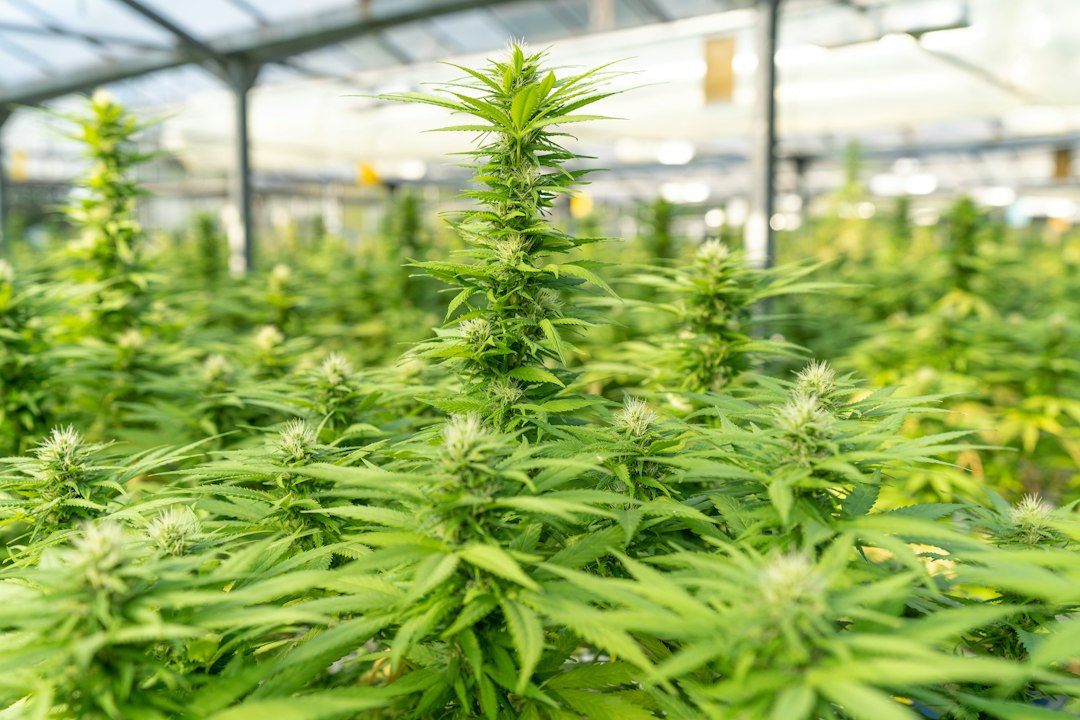 Photo by CRYSTALWEED cannabis
on Unsplash
Photo by CRYSTALWEED cannabis
on Unsplash
- Rescheduling did not open the insurance market. The April 28, 2026 final rule (Federal Register document 2026-08176) moved Food and Drug Administration approved marijuana products and marijuana held under a state medical marijuana license to Schedule III. Adult-use marijuana expressly remained Schedule I, and the order contains no insurance provisions.
- The broader question is still open. The hearing on the 2024 general rescheduling proposal (89 FR 44597) was scheduled to commence June 29, 2026 and to conclude not later than July 15, 2026. As of this review the Drug Enforcement Administration's own regulatory actions index records no recommended decision and no final determination.
- Almost every cannabis policy is non-admitted. That is a coverage fact, not a paperwork detail: the North Carolina Department of Insurance states plainly that "there is no protection for surplus lines policies," and the National Conference of Insurance Guaranty Funds confirms that guaranty-fund coverage "is limited to licensed insurers."
- Price the tax load, not just the premium. A surplus lines placement carries state premium tax and stamping fees on top of the quote — in California, 3% premium tax plus a 0.18% stamping fee at the rate effective January 1, 2023.
- Claims turn on exclusions, not limits. In Green Earth Wellness Center, LLC v. Atain Specialty Insurance Co., the "growing crops" exclusion was held unambiguous and barred roughly $200,000 of mother plants and clones, while the "contraband" exclusion was held ambiguous and sent roughly $40,000 of harvested product to trial.
Is cannabis insurance legal, and what did the April 2026 rescheduling change?
Buying and selling cannabis insurance is lawful in every state that licenses cannabis, and it happens at scale. What federal law changes is not whether a policy can be issued but who is willing to issue one: most admitted carriers treat federal status as the reason to stay out, and the April 2026 rescheduling moved a narrow slice of the market without touching that calculus.
The confusion here is almost entirely secondary-reporting damage. The April 2026 order is routinely described as "marijuana rescheduling," which is true of its subject and false of its scope. Reading the primary text is the whole job, and the four questions below are what that reading produces.
Only partly. The final rule published in the Federal Register on April 28, 2026 (document 2026-08176) moved Food and Drug Administration approved marijuana products and marijuana held under a state medical marijuana license into Schedule III. All other marijuana, including the entire adult-use market, expressly remained in Schedule I.
That distinction is the single most consequential fact in cannabis insurance right now, because most licensed revenue in the United States is adult-use. If your license is adult-use, your product is still a Schedule I controlled substance under federal law, and every underwriting and claims consequence that followed from that is unchanged.
No. The April 2026 order contains no insurance provisions at all. It does not direct, permit, or encourage any insurer to write the class, and nothing in it changes the admitted-market posture that has kept standard carriers out since legalization began.
The National Association of Insurance Commissioners attributes that posture to legal and regulatory uncertainty, and says nothing about loss experience — the NAIC's own account of the admitted market's absence rests on conflicting state and federal law having "largely discouraged insurers," not on the class performing badly. Our cannabis carrier market guide works through who writes the class today and who declines.
Yes, and it is still pending. The Drug Enforcement Administration's hearing on the broader 2024 rescheduling proposal (89 FR 44597) was scheduled to commence on June 29, 2026 and to conclude not later than July 15, 2026, under a notice of hearing published April 28, 2026. As of this review, the agency's own regulatory actions index records no recommended decision and no final determination.
That window has now closed, and the index still records no outcome. Treat any claim that general rescheduling has happened as wrong until the primary source says otherwise: a scheduled hearing is not a completed proceeding, and a completed hearing is not a decision.
A federal court has declined to let an insurer do exactly that. In Green Earth Wellness Center, LLC v. Atain Specialty Insurance Co., 163 F. Supp. 3d 821 (D. Colo. 2016), the court refused to void the policy on public-policy grounds, and it expressly declined to follow the earlier Tracy v. USAA decision that had gone the other way.
That is a genuine protection, but it is narrower than operators often read it. The court let the policy stand and then decided the claim on the policy's own exclusions — which is where most of the money was lost. Federal illegality is rarely the argument that defeats a cannabis claim; the exclusions are. See our cannabis claims guide for how that plays out.
Who actually writes cannabis insurance, and why is nearly all of it surplus lines?
Cannabis is written almost entirely in the excess and surplus lines market by non-admitted carriers, with a small ancillary-only admitted presence and a growing captive and risk-retention-group segment. For a licensed operator that means coverage is available, specialized, and structurally different from an admitted policy in ways that matter at claim time.
An admitted carrier is licensed by your state and its policy is backed by the state guaranty fund. A non-admitted, or surplus lines, carrier is not licensed in that state, is permitted to write risks the admitted market will not take, and sits outside the guaranty system. Our admitted versus excess and surplus explainer covers that distinction in full; the questions below are the cannabis-specific consequences.
Because the obstacle is legal and regulatory uncertainty rather than claims history. The National Association of Insurance Commissioners' own account of the admitted market's absence rests on that uncertainty, not on the class performing badly, which is why a clean loss run does not move an admitted carrier that has decided to stay out of the class entirely.
The NAIC's published account gives legal and conflicting-law reasons and is silent on loss experience — so the fair reading is that the admitted market's absence is not evidence that the class performs badly, rather than evidence that it performs well. This is also why a decline is usually predictable from your application rather than from your record. State, size, occupancy, on-premises consumption, extraction method, and product exposure are the attributes that trigger it, and they are visible before anyone shops the account.
Three differences matter: form, rate regulation, and insolvency protection. A surplus lines carrier writes on its own manuscript forms rather than state-approved standard forms, is not subject to the same rate and form filing requirements, and is outside the state guaranty fund if it fails.
The form difference is the one that surprises people. Two cannabis quotes at the same limit can carry materially different exclusions, because each carrier wrote its own wording. Comparing them on premium alone is comparing the wrong number — see how to compare insurance quotes.
No. The North Carolina Department of Insurance states that "there is no protection for surplus lines policies" and requires the broker to notify the insured in writing that on insolvency "losses will not be paid by any State insurance guaranty or solvency fund." The National Conference of Insurance Guaranty Funds describes the same national rule: coverage "is limited to licensed insurers," and "non-admitted or unlicensed insurance products are not covered," "nor are surplus lines."
The practical response is to underwrite the carrier as carefully as the carrier underwrites you. Financial strength rating, how long the carrier has written the class, and whether it has paid cannabis claims are legitimate questions to ask before binding.
Often, but not inside a standard packaged cannabis program. Combustible hydrocarbon extraction occupancy, consumption on premises, and operations past a program's size envelope are among the attributes that most reliably trigger a decline from the programs that serve the ordinary licensed operator.
A decline from one program is an eligibility fact about that program, not a verdict on your business. Those risks are generally placed individually, with a different carrier set and a different submission. The carrier market guide maps the decline triggers in detail.
What does cannabis insurance cost in 2026, and what rides on top of the quote?
Published median premiums for the class exist but are thin: one placement platform reports a cannabis general liability median of $167 per month, roughly $2,000 a year, at $1 million per occurrence and $2 million aggregate with a $7,500 deductible. The number you actually remit is higher, because a surplus lines placement adds state premium tax and stamping fees on top of the quoted premium.
Treat every figure below as directional. These are medians from one platform's own book, published on pages dated March 18, 2025, and that population skews heavily to businesses with fewer than five employees. Our cannabis insurance cost page works through the drivers the medians cannot reach.
The published medians for the class, from one placement platform's own book, are roughly $167 per month for general liability, $506 per month for a commercial package policy (property and liability bundled) at a $5,000 deductible, and $374 per month for workers' compensation. The same platform's dispensary-specific commercial package policy median runs higher, at about $548 per month.
Those are medians, not quotes, and they come from a population weighted toward very small operators. A cultivation site with meaningful plant value, or a manufacturer running extraction, will not price anywhere near them.
The same platform publishes a small-business general liability median of $45 per month on a page dated March 30, 2026. Set against the cannabis general liability median of $167 per month from its cannabis page dated March 18, 2025, that is roughly a 3.7× difference.
Treat that ratio as directional only. The two figures come from pages published a year apart, both populations skew to businesses with fewer than five employees, and neither is a like-for-like rating exercise. The honest reading is that cannabis prices materially above comparable non-cannabis risk, not that it prices at a precise multiple.
State surplus line premium tax and, in states that have a stamping office, a stamping fee — both calculated on the premium and remitted by the broker rather than absorbed by the carrier. In California the combination is a 3% premium tax plus a 0.18% stamping fee, at the stamping-fee rate effective January 1, 2023.
This is why two quotes can be presented at the same number and cost different amounts. A quote shown gross of tax and fees will always look better than one shown net of them. Ask which basis you are being given before comparing.
Programs set one, and it binds small operators more than rating does. One cannabis program Anvo has reviewed sets a $500 minimum for monoline general liability and a $250 minimum for business personal property per location — those are that program's terms, not a market-wide rule.
The practical effect is that a very small licensed operation can find its premium set by the program's floor rather than by its own exposure, which makes shopping on rate alone unproductive at the bottom of the market.
What insurance does my state cannabis license actually require?
Several licensing states write an insurance requirement directly into their cannabis regulations, so for a licensed operator the floor under the policy is regulatory rather than commercial. California sets its requirement in title 4, section 15308 of the California Code of Regulations; Massachusetts in 935 CMR 500.105(10); Washington in WAC 314-55-082.
Read the regulation's own words rather than a summary of them, because the wording decides how the limit is measured. Our cannabis insurance requirements by state page carries the current limits and the exact regulatory language for the states it maps.
In several licensing states, yes — the requirement sits in the cannabis regulations themselves rather than in general insurance law. California (4 CCR §15308), Massachusetts (935 CMR 500.105(10)) and Washington (WAC 314-55-082) each impose one on licensees.
Requirements are not uniform across states and they change, so confirm the current rule with your own regulator before you renew. Where a state does impose one, failing it is a licensing problem before it is an insurance problem.
Because it may not line up with how your policy measures the same limit. The regulation's own term is "for each loss." Most commercial general liability policies are written per occurrence, and the two phrases are not automatically interchangeable — an occurrence can encompass more than one loss.
The practical step is to read the regulation's wording against your policy's trigger and limit structure before you assume the certificate satisfies the rule. This is a question worth putting to your broker in writing.
No. Each state writes its own requirement in its own regulation, and they differ in limits, in what they measure, and in which licence categories they reach. Massachusetts' sits at 935 CMR 500.105(10), Washington's at WAC 314-55-082, and California's at 4 CCR §15308.
Massachusetts amended 935 CMR 500 by emergency regulation in June 2026, and on our last review of the text the insurance subsection, 500.105(10), was unchanged by it — a useful reminder that a cannabis regulation can be amended without its insurance subsection moving at all. Check the current text before you rely on either point.
Almost certainly not. A licensing minimum is a compliance floor set by a cannabis regulator, not an assessment of your exposure. It typically addresses one liability line and says nothing about your stock, your equipment, your business interruption exposure, your employees, or your products.
Landlord and lender requirements frequently exceed the state floor, and product exposure usually exceeds both. Price the regulatory floor first, then build the rest of the program on what you actually stand to lose — see our cannabis business insurance guide for the full coverage stack.
Which exclusions actually decide cannabis claims?
Cannabis claims are usually decided by exclusions rather than by limits, and the exclusions that decide them were drafted for other industries — growing crops, contraband, your-product damage, and dishonest or criminal acts. Reading those four against your own operation is a better use of an hour than negotiating a higher limit.
The leading decision remains Green Earth Wellness Center, LLC v. Atain Specialty Insurance Co., 163 F. Supp. 3d 821 (D. Colo. Feb. 17, 2016), and it cuts both ways in the same opinion. Our cannabis claims guide walks the process end to end.
It decided two exclusions in opposite directions in one opinion. The court held the "growing crops" exclusion unambiguous — reading it to mean "any body of plants tended for their agricultural yield, at least until they are harvested" — and barred roughly $200,000 for mother plants and clones. It held the "contraband" exclusion ambiguous and sent roughly $40,000 of harvested buds and flowers to trial.
It matters because it is still the clearest judicial statement of how cannabis property losses get sorted, and because the dividing line it drew is the plant's own life stage rather than anything the insured chose.
Not automatically, and in Green Earth they were not. Where a policy carries a "growing crops" exclusion, living plants can fall outside it entirely while harvested product is treated differently — so the stage of the plant's life at the moment of loss can be worth more than any endorsement on the policy.
If cultivation is your business, the question to ask before binding is not what your limit is but whether living plants are inside or outside the grant, and at what point in the cycle that changes. Programs that advertise seed-through-sale property are responding to exactly this gap.
No. The Texas Department of Insurance states that a commercial general liability policy "will not pay the cost to recall faulty products, work, or impaired property," and that recall coverage "may be added to the policy by endorsement for an additional premium charge." The same guidance notes that general liability policies "don't cover property damage to your product arising out of the product or any part of the product."
Product recall and product liability are different things covering different losses: liability responds to harm your product does to someone else, recall responds to the cost of getting it back. For a licensed cannabis manufacturer facing a state-mandated recall, that gap is the whole exposure — see product recall and contamination insurance.
A landlord's claim has been denied on those facts. In K.V.G. Properties, Inc. v. Westfield Insurance Co., No. 17-2421 (6th Cir. Aug. 21, 2018), a dishonest-or-criminal-acts exclusion barred a landlord's roughly $500,000 claim for damage done by cannabis-growing tenants, the court observing that "[t]he policy says 'criminal act,' not 'crime' or 'criminal conviction.'"
Read that holding narrowly. The court expressly declined to decide whether the clause's "anyone to whom you entrust the property for any purpose" limb reaches tenants at all, noting that the list of roles "does not include tenants" and expressing "no opinion on this issue." The case is a warning to landlords about how the exclusion was applied on its facts, not authority that tenants are covered persons under it. If you lease to or from a licensed operator, the lease and the policy need to be read together before anything goes wrong.
The questions arrive in the wrong order
Across the hard-to-place classes we review, the questions come to us in a consistent and consistently unhelpful order: price first, coverage second, eligibility last. For most commercial classes that order is harmless, because eligibility is rarely in doubt. For cannabis it inverts the work. The eligibility answer frequently moots the price question entirely — a quote on an operation a program will not write is not a cheap quote, it is no quote.
The pattern we try to establish early is the reverse: confirm which markets can write the operation as it actually runs, then read the forms those markets use, then talk about premium. It is a slower first conversation and a much shorter second one, and it avoids the outcome we see most often in this class — an operator who has compared three numbers that were never going to be offered.
Details anonymized and generalized to protect client confidentiality.
The rest of the cannabis insurance library
This page is deliberately short-form. Each answer above has a long-form counterpart that carries the full citations, the tables, and the state-by-state detail. Start with the pillar if you are new to the class, or go straight to the page matching the question you came in with.
- Cannabis business insurance guide: the pillar — the federal picture, placement reality, the full coverage stack and the six-item exclusion audit.
- Cannabis carrier market guide: who writes the class, who declines, and the decline triggers you can read off your own application.
- Cannabis insurance cost in 2026: the published medians, the non-admitted tax load, and the drivers the medians miss.
- Cannabis insurance requirements by state: the regulatory floors and the exact wording each state uses.
- Cannabis insurance claims guide: the claim process end to end and the exclusions that decide it.
- Coverage detail: general liability, product liability, commercial property, business interruption, workers' compensation, commercial auto, umbrella and excess.
- Buyer education: questions to ask your insurance broker and the insurance glossary.
Still have a cannabis insurance question this page did not answer?
Ask it here and get an answer grounded in Anvo's cannabis insurance library.
Find out whether your operation is placeable before you shop on price
Anvo is an independent commercial brokerage. Tell us how your licensed operation actually runs and we will tell you which markets can write it — and which cannot, and why.