
Hazmat Trucking Insurance:
The MCS-90, Federal $1M/$5M Financial Responsibility, and Why Hazmat Haulers Live in the Specialty Market
Hazmat trucking insurance is a specialty commercial-auto and liability program built for carriers that transport hazardous materials. It differs from a standard trucking policy in three ways: the federal financial-responsibility floor is $1,000,000 or $5,000,000 instead of $750,000; the policy must carry the MCS-90 endorsement guaranteeing the public that money is available for cleanup and injury; and the pollution and cargo exposures that come with hazmat routinely fall into coverage gaps a standard truck policy was never designed to fill.
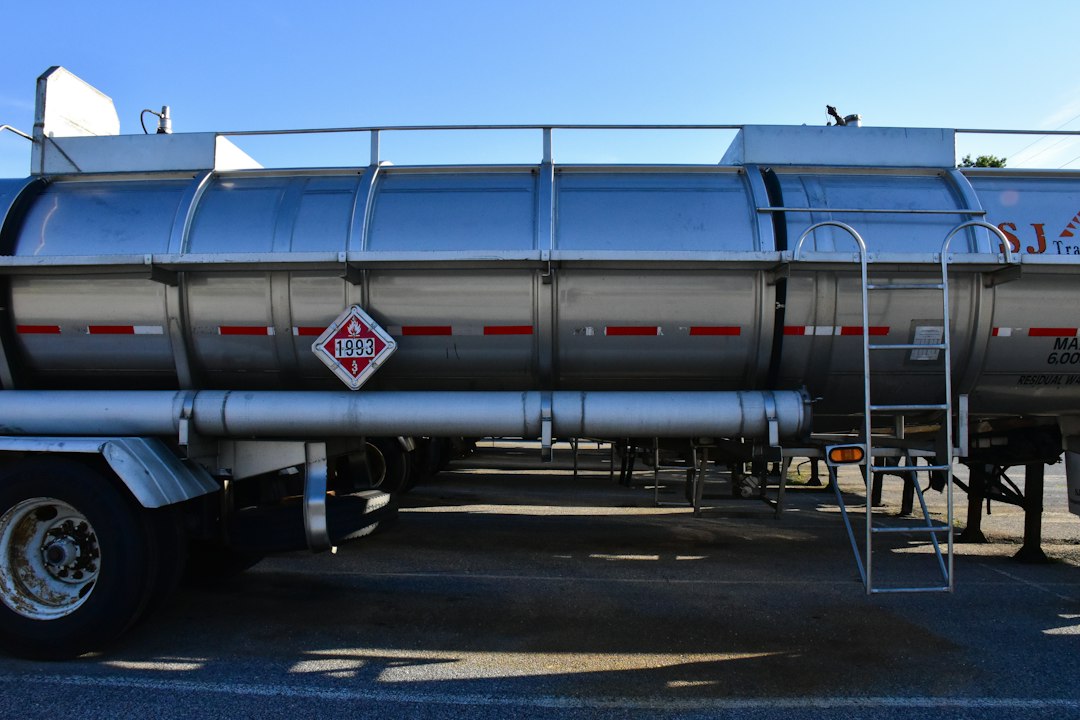 Photo by Jason Mitrione
on Unsplash
Photo by Jason Mitrione
on Unsplash
- The Federal Motor Carrier Safety Administration (FMCSA) sets the auto-liability floor for hazmat haulers at $1,000,000 for many hazardous materials and $5,000,000 for bulk hazardous substances and certain gases — versus $750,000 for general freight (49 CFR 387.9).
- The MCS-90 endorsement is not insurance for your business. It is a public guarantee: the insurer pays a third party even when a claim would otherwise be excluded, then has the right to collect that money back from you.
- Carriers hauling the highest-risk materials also need a federal Hazardous Materials Safety Permit (HSP) and annual Pipeline and Hazardous Materials Safety Administration (PHMSA) registration on top of insurance.
- Standard auto and general-liability policies carry an absolute pollution exclusion, so the cleanup and environmental tail — often the most expensive part of a hazmat loss — is exactly where coverage gaps hide.
- Hazmat is largely a specialty and excess-and-surplus (E&S) market; underwriters price it on your safety record, driver qualifications, and the specific commodities you carry, not on a standard rate table.
Why hazmat hauling is underwritten as a class of its own
Hazmat hauling is treated as a separate underwriting class because three exposures compound: a single incident can be catastrophic, the federal government mandates far higher liability limits, and the environmental cleanup that follows a release is the kind of loss standard trucking policies were built to exclude. A carrier that adds even one placarded load to an otherwise ordinary fleet has changed its risk profile enough that most standard markets re-rate it or decline it.
Start with severity. A dry-van rollover is a vehicle-and-cargo loss; a tanker rollover carrying a flammable or toxic product can become a highway closure, an evacuation, a fire, a waterway contamination, and a multi-agency response — all from the same accident. That is why the commercial trucking insurance program for a hazmat operation is not just a bigger version of a standard one; it is structured around a tail of consequences a general-freight carrier rarely faces.
Next is the federal floor. Under 49 CFR 387.9, the FMCSA requires most for-hire carriers of general freight to carry $750,000 in auto liability, but that jumps to $1,000,000 for many hazardous materials and to $5,000,000 for bulk hazardous substances, oil, and certain gases moved in cargo tanks. Those are minimums to operate legally, not recommendations — and on the kind of loss hazmat produces, the minimum is often nowhere near enough, which is why umbrella and excess layers matter here more than almost anywhere else in trucking. Operators new to hazmat should also see our trucking industry overview for how the core program fits together before the hazmat surcharges layer on.
What you must file, register, and permit before you haul hazmat
Insurance is only one layer. To operate legally, a hazmat carrier assembles a stack of federal obligations: proof of financial responsibility filed with the FMCSA, an MCS-90 endorsement on the policy, annual registration with the Pipeline and Hazardous Materials Safety Administration, a Hazardous Materials Safety Permit for the highest-risk commodities, and drivers who hold a hazmat-endorsed commercial driver's license. Miss one and you can be compliant on paper for a standard fleet yet illegal to move a single placarded load.
Your broker coordinates the pieces that touch insurance — the BMC-91 liability filing and the MCS-90 endorsement — but registration, permitting, and driver credentialing are the carrier's own responsibility. The table below shows how the stack fits together. Several of these obligations also appear on our trucking insurance requirements guide, which covers the state-by-state layer on top of the federal one.
| Obligation | What it is | Who needs it | Authority |
|---|---|---|---|
| BMC-91 + MCS-90 | Proof-of-insurance filing with FMCSA and the endorsement that guarantees the public financial responsibility | All for-hire motor carriers; hazmat raises the underlying limit to $1M or $5M | FMCSA, 49 CFR 387 |
| PHMSA registration | Annual registration of anyone who offers or transports certain hazardous materials | Carriers of placarded and other listed hazmat; runs July 1–June 30 | PHMSA, 49 CFR 107 Subpart G |
| Hazardous Materials Safety Permit (HSP) | An FMCSA permit for carriers moving the most dangerous commodities; valid two years | Only carriers of the specific high-risk materials listed below | FMCSA, 49 CFR 385 Subpart E |
| Hazmat (H) endorsement | A commercial driver's license (CDL) endorsement requiring a Transportation Security Administration (TSA) security threat assessment (STA) | Every driver who hauls placarded loads | TSA, 49 CFR 1572 |
The Hazardous Materials Safety Permit is narrower than people assume — it is required only for the most dangerous shipments, not for hazmat generally. A carrier needs one to move a highway route-controlled quantity (HRCQ) of Class 7 radioactive material, more than 25 kilograms (55 pounds) net weight of the most sensitive explosives (Division 1.1, 1.2, or 1.3), or more than one liter per package of a material poisonous by inhalation (PIH), among a short list of bulk toxic and flammable gases. The permit has been mandatory for covered carriers since January 1, 2005 and is renewed on a two-year cycle.
The MCS-90 is a public guarantee, not coverage for your business
The MCS-90 endorsement is the single most misunderstood piece of a hazmat program. It exists to protect the public, not the carrier: it obligates the insurer to pay an injured third party up to the federal financial-responsibility limit even when the loss would otherwise be excluded — and then gives the insurer the right to recover that payment from the carrier. Treat it as a surety-style backstop for the public, not as broad insurance you can lean on.
That distinction has teeth. If a loss is excluded by your actual policy but the MCS-90 forces the insurer to pay a claimant, the insurer can and will seek reimbursement from you for every dollar it advanced. Carriers who assume the MCS-90 "covers hazmat" discover at the worst possible moment that it covered the public and left them holding the bill. This is also why the interaction between the endorsement and your underlying coverage belongs in any conversation about a real loss — see our trucking claims guide for how these coordinate when a claim actually hits.
Just as important is what the MCS-90 does not touch. It does not pay to repair or replace your tractor or trailer, it does not cover your cargo, and it does not fund first-party cleanup on your own account. It responds to public bodily injury and property damage claims within the federal limit — the truck, the load, and much of the environmental tail sit outside it and must be insured separately.
The pollution and cargo gaps that sink hazmat haulers
The most expensive part of a hazmat loss is usually the cleanup, and cleanup is exactly what a standard truck policy is built to exclude. Both commercial auto and general-liability forms carry an absolute pollution exclusion, and the federal cleanup regime under the Comprehensive Environmental Response, Compensation, and Liability Act (CERCLA) can reach the carrier that spilled the product. Closing the gap takes a deliberately assembled program, not a single policy.
A properly built hazmat program layers several coverages so the environmental and cargo tail is actually funded rather than assumed. Your commercial auto liability answers the driving loss up to the federal limit; a limited pollution or "broadened pollution" endorsement and, where warranted, a separate environmental/contractor's pollution policy address the release and remediation; motor truck cargo insures the product itself, including contamination of a load; and general liability handles premises and completed-operations exposures the auto policy will not. The pollution mechanics overlap heavily with what warehouse and distribution operators face — our food-distribution hazmat guide walks the same exclusion from the shipper's side.
Six gaps show up again and again when we audit a hazmat operation's existing coverage:
- Relying on the MCS-90 as if it were pollution coverage: it pays the public and then bills you back; it is not a substitute for a real pollution or environmental policy.
- The absolute pollution exclusion left unaddressed: without a broadened pollution endorsement or a standalone environmental policy, the cleanup — often the largest single number in the loss — is uninsured.
- Cargo limits set for the truck, not the load: motor truck cargo written at a generic limit can fall short of the value and cleanup cost of a contaminated or released hazmat shipment.
- Federal-minimum liability on contracts that demand more: shippers and terminals frequently require $2M–$5M and specific endorsements; the FMCSA minimum satisfies the government, not the contract.
- No umbrella over a catastrophic-severity exposure: hazmat is the classic case where the primary limit is exhausted first — umbrella and excess layers are where the real protection sits.
- Loading, unloading, and transfer treated as an afterthought: many hazmat releases happen at the rack or dock, not on the road, and coverage for those operations is easy to leave out.
Why hazmat lives in the specialty and E&S market
Most standard trucking markets either decline hazmat or write only the mildest end of it, so hazmat placements concentrate in specialty program markets and the excess-and-surplus (E&S) market. Underwriters there price the account on its safety record, its drivers, and the exact commodities it carries — there is no standard rate table, and two hazmat carriers of the same size can be priced very differently.
What underwriters look at is specific. A clean Compliance, Safety, Accountability (CSA) record — especially the hazmat compliance category — carries real weight, as do documented driver qualification files, current cargo-tank testing and specification records, a written security plan, and evidence that loading and unloading procedures are controlled. Carriers that present these well are placed with specialty markets; those with gaps drift toward the harder end of E&S and pay for it. For the broader placement picture, our trucking carrier-market guide maps how admitted, program, and E&S tiers fit together, and the commercial fleets hub covers the multi-power-unit view.
In our book, we typically see a clean single-power-unit hazmat program priced well above a comparable dry-van operation — often in the range of $16,000 to $40,000 or more in the first year, depending on the commodity, radius, and driver profile — with the highest-risk materials (bulk PIH, explosives, radioactive) sitting higher still and living almost entirely in E&S. We present those as agency-experience ranges, not quotes: your number depends on your loss history, your filings, and the specific hazmat classes on your authority.
When the MCS-90 paid the public and then came looking for the carrier
A small regional tanker operation hauling flammable liquids came to us after a single-vehicle rollover on a rural highway. The driver was fine, but the load released, a drainage ditch was contaminated, and a state environmental agency ordered remediation. The carrier's prior program had the required MCS-90 and met the federal limit — and the owner had understood that endorsement to mean "hazmat is covered."
It did not mean that. The MCS-90 stood behind the third-party claims, but the carrier's underlying auto and general-liability forms both carried the absolute pollution exclusion, so the cleanup — the largest number in the loss — was uninsured, and the insurer had grounds to seek reimbursement for part of what the endorsement forced it to advance. We rebuilt the account with a broadened pollution endorsement, a standalone environmental layer sized to the commodity, cargo limits set to the released-load scenario rather than the truck value, and an umbrella above the primary. The premium rose materially, but the next incident — a smaller transfer-rack spill — was funded cleanly instead of coming out of the business.
Details anonymized and generalized to protect client confidentiality.
Frequently asked questions about hazmat trucking insurance
Under 49 CFR 387.9, the Federal Motor Carrier Safety Administration requires $1,000,000 in auto liability for many hazardous materials and $5,000,000 for bulk hazardous substances, oil, and certain gases — versus $750,000 for general freight. Those are legal minimums, not adequacy targets.
Because hazmat losses are catastrophic-severity by nature, most carriers carry umbrella or excess limits well above the federal floor, and shipper contracts frequently require more than the minimum on their own terms.
The MCS-90 is a federal endorsement that guarantees the public will be paid for bodily injury and property damage up to the required financial-responsibility limit, even on an otherwise-excluded loss. It does not cover your tractor, trailer, or cargo, and the insurer can recover from you whatever it pays under it.
Think of the MCS-90 as a surety-style backstop for third parties, not as broad insurance for your business — physical damage, cargo, and pollution all need separate coverage.
Only if you haul the highest-risk commodities. A Hazardous Materials Safety Permit is required for a highway route-controlled quantity of Class 7 radioactive material, more than 25 kilograms of the most sensitive explosives, more than one liter per package of a poison-inhalation-hazard material, and a short list of bulk toxic and flammable gases.
Most placarded hazmat does not trigger the permit, but nearly all placarded hazmat does trigger annual PHMSA registration and a hazmat-endorsed driver — so confirm which obligations actually apply to your commodities.
No. Standard commercial auto and general-liability forms carry an absolute pollution exclusion, so the cleanup and remediation costs — often the largest part of a hazmat loss — are not covered unless you add a broadened pollution endorsement or a separate environmental policy.
This is the most common and most expensive gap we see: carriers who assume the MCS-90 or their auto policy handles cleanup, and learn otherwise only after a release.
Hazmat programs price well above comparable general-freight operations, and there is no standard rate table — the number turns on your commodities, radius, safety record, and drivers. In our book, a clean single-power-unit hazmat program often runs in the range of $16,000 to $40,000 or more in the first year, with the highest-risk materials sitting higher.
Those are agency-experience ranges, not quotes. See our commercial trucking insurance cost guide for how the underlying coverage lines and drivers of premium fit together.
It is possible but harder and more expensive. A new authority already pays a first-year surcharge for having no safety history, and adding hazmat on day one pushes the account into the excess-and-surplus market, where many standard new-authority writers will not follow.
Carriers usually place better by building a clean record first. Our new-authority trucking insurance guide explains the first-year surcharge mechanics that hazmat compounds.
Yes. An owner-operator hauling hazmat faces the same $1M/$5M federal floor, MCS-90, PHMSA registration, and hazmat-endorsed license as a fleet, but has to carry them on a single-truck economy — so the pollution and cargo gaps hit proportionally harder.
Whether leased-on or on their own authority, the hazmat layer changes the program. Our owner-operator insurance guide covers the leased-on-versus-own-authority structure the hazmat rules sit on top of.
Because the severity and the environmental tail are outside what a standard commercial-auto book is built to price. Most standard markets either exclude hazmat or write only the mildest end of it, which concentrates hazmat placements in specialty program markets and the excess-and-surplus market.
That is why presentation matters so much for hazmat accounts. Our commercial trucking insurance FAQ answers the broader placement and coverage questions that apply across every trucking operation.
Not sure your hazmat program actually covers the cleanup?
Ask about the MCS-90, the federal $1M/$5M limits, and the pollution and cargo gaps that hide in a standard truck policy.
Haul hazmat? Let's pressure-test your program before a loss does.
We will check your MCS-90, your federal limits, your pollution and cargo coverage, and your filings — and tell you where the gaps are. Start with a quick conversation.