
Auto Repair Shop Insurance Requirements by State:
What the Law, Your State, and Your Contracts Actually Require
No state makes you buy a single "auto repair shop policy" — but nearly every shop is bound by three overlapping layers of insurance requirements: state workers' compensation and auto liability statutes, federal environmental rules for used oil and waste handling, and the contractual demands in leases, dealer agreements, and fleet service contracts. This guide separates what is legally required from what is contractually required, state by state.
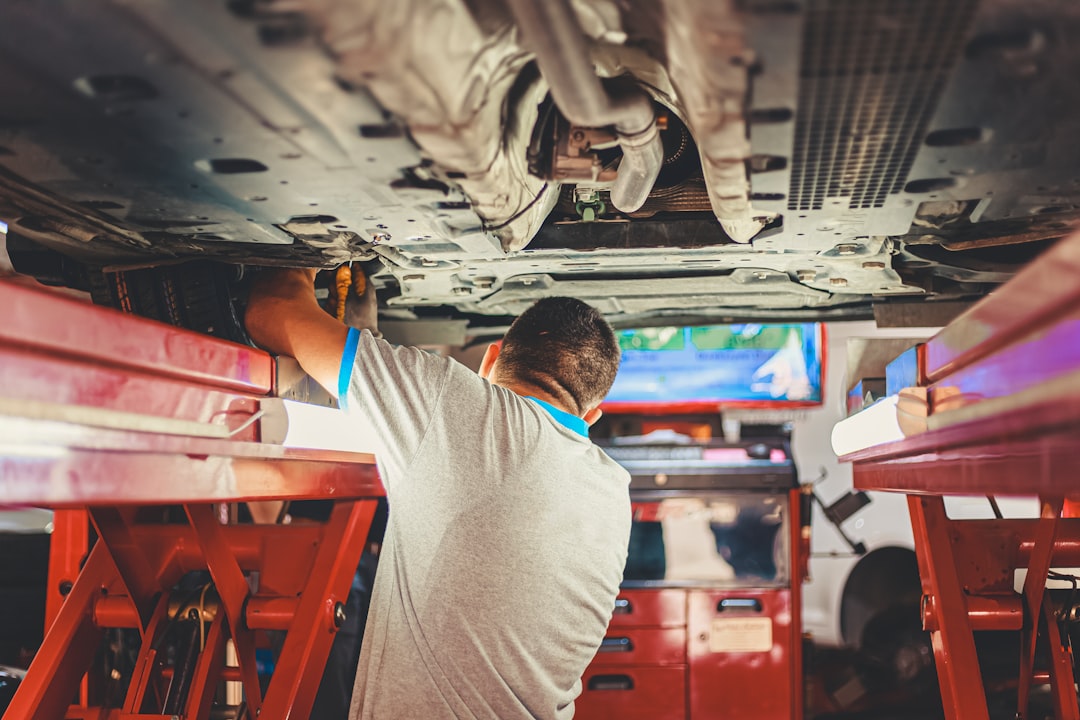 Photo by Enis Yavuz
on Unsplash
Photo by Enis Yavuz
on Unsplash
- Workers' compensation is the most universal legal requirement: New York, Pennsylvania, and California require it from the first employee; Missouri from 5 employees; Kansas once annual payroll exceeds $20,000.
- Shop-owned vehicles (tow trucks, parts runners, loaners) must meet state auto liability minimums — California raised its floor to $30,000/$60,000/$15,000 on January 1, 2025 under SB 1107.
- New York is the strictest registration state: the DMV Repair Shop Act requires registration (Form VS-1, $150 per two years) with proof of workers' compensation and disability coverage if you have employees.
- The EPA's used-oil rule (40 CFR Part 279) creates environmental liability that standard policies exclude — a legal exposure most shops never see until a claim.
- Contractual requirements — landlord leases, dealership sublet agreements, fleet service contracts — routinely demand more coverage than any statute, typically $1M per occurrence general liability plus garagekeepers at stated limits.
The three layers of auto repair shop insurance requirements
Auto repair shop insurance requirements come from three sources: statutory requirements (state workers' compensation and vehicle financial responsibility laws, plus registration acts like New York's), federal environmental regulations (EPA used-oil and hazardous waste rules), and contractual requirements (leases, dealer sublet agreements, fleet contracts). Contractual demands are almost always the highest of the three.
Most shop owners assume "required insurance" means whatever the state mandates. In practice, the statutory layer is thin — workers' compensation and auto liability on shop-owned vehicles are the only coverages most states directly require of an auto repair business. The layer that actually shapes a shop's insurance program is contractual: the landlord who requires $1 million in general liability (GL) with additional insured status, the dealership that subcontracts overflow work but requires garagekeepers coverage at specific limits, or the fleet account that will not send its first vehicle without a certificate of insurance (COI).
The full coverage architecture for a shop — garage liability, garagekeepers, property, workers' comp, and commercial auto — is covered in our complete auto repair shop insurance guide. This page focuses on which pieces of that program are required, by whom, and at what level.
State workers' compensation thresholds for auto repair shops
Workers' compensation is legally required for auto repair shops in every state once an employee threshold is met: New York, Pennsylvania, and California require coverage from the first employee; Missouri requires it at five or more employees; Kansas requires it once annual payroll exceeds $20,000. Repair work has no meaningful exemptions in any of these states.
Auto repair is a hands-on trade with real injury frequency — lifts, impact tools, hot exhaust systems, and vehicle movement inside the bay. That is reflected in how the work is rated: shops are classified under National Council on Compensation Insurance (NCCI) class code 8380 (automobile service or repair centers), which carries benchmark rates of roughly $2.15 per $100 of payroll — several times the rate of clerical classes. Workers' compensation is also the statutory coverage regulators actually verify: New York checks it at repair shop registration, and every state in the table below penalizes uninsured employers with fines, stop-work orders, or personal liability for injury costs.
| State | Workers' comp required when… | Regulator |
|---|---|---|
| Kansas | Annual payroll exceeds $20,000 | Kansas Department of Labor |
| Missouri | 5 or more employees (construction trades: 1+) | MO Division of Workers' Compensation |
| Pennsylvania | 1 or more employees, including part-time | PA Department of Labor & Industry |
| New York | 1 or more employees; verified at DMV shop registration | NY Workers' Compensation Board |
| California | 1 or more employees, no exceptions | CA Division of Workers' Compensation |
Two traps we see repeatedly. First, "family shops" that treat relatives as exempt — New York and California count family members as employees for coverage purposes. Second, misclassifying technicians as 1099 contractors: state boards apply their own control tests, and a reclassified "contractor" injury becomes an uninsured claim the owner pays personally.
State auto liability minimums and shop registration requirements
Any vehicle titled to the shop — tow truck, parts runner, shuttle, or loaner — must carry at least the state's minimum auto liability limits. As of 2026 those floors are $25K/$50K/$25K in Kansas (K.S.A. 40-3107) and Missouri (RSMo §303.190), $15K/$30K/$5K in Pennsylvania (75 Pa.C.S. §1702), $25K/$50K/$10K in New York (NY VTL §311; NY DMV), and $30K/$60K/$15K in California (SB 1107; CA DMV).
State minimums are a legal floor, not a program. A shop moving customer vehicles all day has commercial exposure the personal-lines minimums were never designed for — which is why leases and dealer contracts typically require $1 million combined single limit on commercial auto. California's increase is worth flagging: Senate Bill 1107 (the Protect California Drivers Act) doubled the former 15/30/5 minimums effective January 1, 2025, with a further scheduled increase to 50/100/25 in 2035 — renewals written at old limits are out of compliance.
Registration states: New York and California
A handful of states regulate repair shops as registered businesses, and two of Anvo's licensed states are the strictest examples. New York's Repair Shop Act requires every shop to register with the Department of Motor Vehicles (Form VS-1, $10 application fee plus $150 registration per location for two years); shops with employees must submit proof of workers' compensation and disability benefits coverage with the application. Operating unregistered is grounds for civil penalties and closure. California requires every automotive repair dealer to register with the Bureau of Automotive Repair (BAR) under the Automotive Repair Act; BAR registration does not itself mandate insurance, but shops performing smog checks, brake-and-lamp certification, or towing frequently face insurance conditions in their station licenses and municipal permits.
Federal environmental requirements: used oil, waste, and the pollution gap
The federal government does not require repair shops to buy insurance, but the EPA's used-oil management standards (40 CFR Part 279) impose legal duties — proper storage, labeling, leak response, and use of registered transporters — whose violation creates liability that standard general liability policies exclude under the absolute pollution exclusion.
Every shop that changes oil is a "used oil generator" under 40 CFR Part 279. The rules are manageable: keep tanks and containers in good condition, label them "Used Oil," clean up releases, and ship through transporters with EPA identification numbers. The trap is the mixture rule — used oil contaminated with more than 1,000 parts per million of total halogens (brake cleaner and carb-cleaner solvents are the usual culprits) is presumed to be hazardous waste, which moves the shop into a far stricter regulatory regime with real disposal-cost and enforcement consequences (see the pollution section of our auto repair insurance guide for the full breakdown).
The insurance implication: a heating-oil-style release from a used-oil tank, or a contaminated-soil claim from a landlord at lease-end, lands in the gap created by the pollution exclusion in standard GL and commercial property forms. Shops with above-ground used-oil storage, floor drains, or a history at older sites should price a garage pollution endorsement or a standalone storage tank/pollution policy — not because a statute demands the policy, but because the statute creates the liability. What that gap looks like when a claim actually lands is in our claims guide.
- 40 CFR Part 279 (used oil): storage, labeling, release response, and transporter duties for every generator — no minimum volume. (eCFR, Part 279)
- Mixture rule: used oil above 1,000 ppm total halogens is presumed hazardous waste — a compliance cliff, not a slope.
- OSHA general duty: no insurance mandate, but recordable lift, chemical, and eye injuries feed directly into the workers' comp experience mod that sets your premium.
Contractual requirements: leases, dealer agreements, and fleet contracts
Contracts, not statutes, set the real insurance bar for most repair shops. Commercial leases typically require $1 million per occurrence / $2 million aggregate general liability with the landlord as additional insured; dealership sublet and fleet service agreements add garagekeepers coverage at stated limits, often on a direct-primary basis rather than legal-liability-only.
Three contract families drive the requirements. Leases: beyond the standard $1M/$2M GL demand, auto-shop leases frequently require property coverage on tenant improvements, waiver of subrogation, and sometimes environmental remediation responsibility for contamination discovered at move-out — which is where the Part 279 exposure above becomes a lease default. Dealer and sublet agreements: a dealership sending overflow work will specify garagekeepers limits sized to their inventory values and usually require the direct-primary form, because legal-liability-only garagekeepers pays nothing when the shop isn't negligent (a hail loss in your lot, for example) — the distinction our pillar guide treats as the single most misunderstood item in shop insurance. Fleet accounts: commercial fleet maintenance contracts demand COIs showing GL, garagekeepers, workers' comp, and commercial auto, often with an umbrella layer of $1M–$5M for larger accounts.
The practical rule: collect every insurance clause from every active contract once a year and reconcile them against the program. A shop that meets its statutory obligations but breaches a lease insurance clause has a compliance problem the state never told it about. A business owner's policy (BOP) can satisfy the GL and property demands for smaller shops, but garagekeepers and pollution almost always need to be added deliberately.
Registered with the state, out of compliance with the lease
A pattern we see when reviewing shop programs: the owner has done everything the state asked — workers' comp in place, shop-owned vehicles at or above statutory limits, registration current — and assumes that means "fully compliant." Then a landlord's property manager runs a COI audit and finds the lease requires $1 million per occurrence GL with additional insured status, while the shop carries $500K with no endorsement. The shop was never illegal; it was in breach of contract for years without knowing, and the audit landed at the worst time — mid-renewal, with little leverage.
The fix is administrative, not expensive: reconciling the lease's insurance exhibit against the policy, raising the GL limit, and adding the endorsement typically moves the premium modestly (benchmarks in our 2026 cost guide). The lesson is that statutory compliance and contractual compliance are separate audits — and only one of them generates a government reminder.
Details anonymized and generalized to protect client confidentiality.
Frequently asked questions about auto repair shop insurance requirements
No state requires a general "auto repair shop policy." What states do require is workers' compensation once you cross the employee threshold (first employee in NY, PA, and CA; 5 employees in MO; $20,000 payroll in KS) and minimum auto liability on any shop-owned vehicle. New York additionally requires DMV shop registration with proof of workers' comp.
Everything else — general liability, garagekeepers, property — is driven by your lease and customer contracts rather than statute.
In New York, Pennsylvania, and California — yes, from the first employee, including part-time workers and, in most cases, family members. In Missouri the trigger is five employees; in Kansas it is $20,000 of annual payroll, which one part-time tech can exceed.
Misclassifying a technician as a 1099 contractor does not remove the obligation if the state's control test says they're an employee.
New York's DMV Repair Shop Act requires registration via Form VS-1 ($10 application fee plus $150 per location for two years). If the shop has employees, the application must include proof of workers' compensation and disability benefits coverage. Operating unregistered exposes the shop to civil penalties and closure.
No — neither is a statutory requirement in any of our licensed states. Garagekeepers becomes "required" contractually: dealership sublet agreements, fleet maintenance contracts, and some landlords demand it at stated limits, frequently on a direct-primary basis rather than legal-liability-only.
Practically, no shop should hold customer vehicles without it regardless of what contracts demand.
The 2026 statutory floors in our licensed states, set by each state's financial responsibility law: Kansas and Missouri $25K/$50K/$25K (K.S.A. 40-3107; RSMo §303.190), Pennsylvania $15K/$30K/$5K (75 Pa.C.S. §1702), New York $25K/$50K/$10K (NY VTL §311), and California $30K/$60K/$15K (raised January 1, 2025 by SB 1107). These are per-person bodily injury / per-accident bodily injury / property damage limits.
Commercial contracts typically require $1 million combined single limit — far above every statutory floor.
Almost always. A typical auto-shop lease requires $1M per occurrence / $2M aggregate general liability with the landlord as additional insured, plus property coverage and waiver of subrogation — none of which any statute mandates. Some leases also assign environmental cleanup responsibility, which connects directly to the EPA used-oil exposure.
Breaching the insurance clause is a lease default even when the shop is fully legal in the state's eyes.
Not sure if your shop meets its requirements?
Ask about your state's thresholds, your lease's insurance clause, or what a dealer contract will demand.
Check whether your current insurance meets your requirements
We'll reconcile your policies against your state's statutes, your lease, and every dealer or fleet contract — and show you exactly where the gaps are.