
Auto Repair Shop Insurance FAQ:
18 Questions Shop Owners Actually Ask
Auto repair shops typically carry general liability (or a garage liability form), garagekeepers coverage for customer vehicles, commercial property, and workers' compensation. General liability averages $54 per month (Insureon, 2026), and garagekeepers averages $458 per year — though market pricing commonly runs $1,000–$1,300. These 18 answers cover coverage, cost, state requirements, claims, and specialty risks.
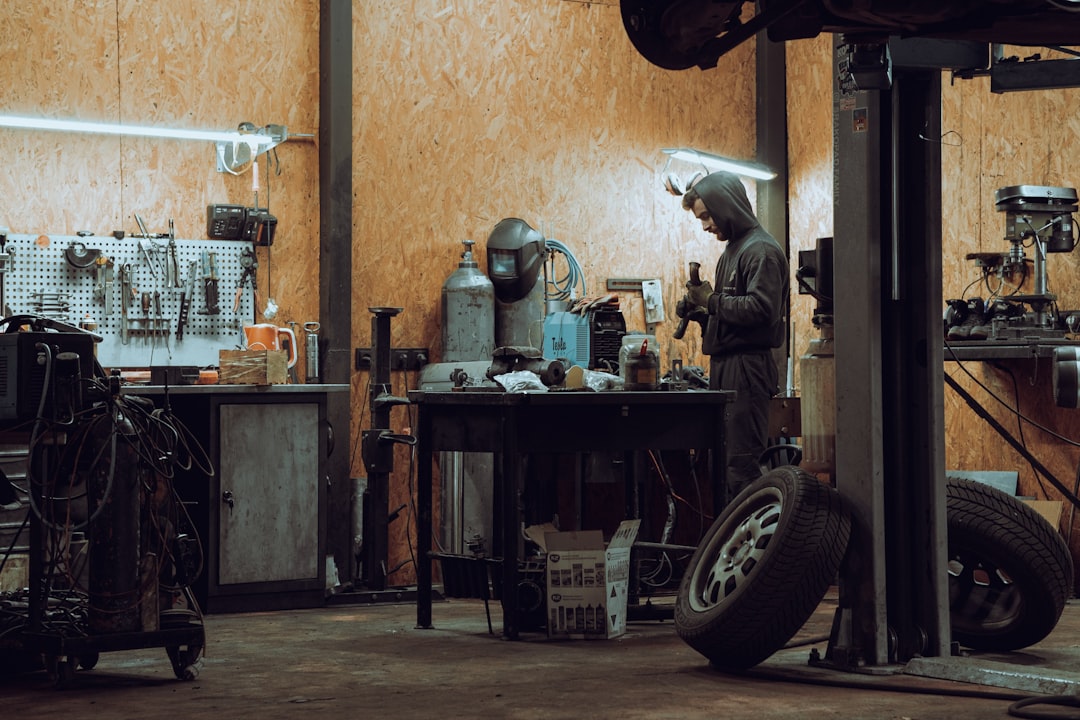 Photo by Raymond Yeung
on Unsplash
Photo by Raymond Yeung
on Unsplash
- General liability (GL) for auto repair shops averages $54/month (~$652/year), and a full small-shop program typically runs $2,500–$5,500/year (Insureon 2026; Anvo program scenarios).
- Garagekeepers coverage — protection for customer vehicles in your care — is the most commonly misunderstood policy in the garage program: the legal-liability vs. direct-primary form choice decides whether hail, theft, and no-fault losses to customer cars are paid.
- Workers' compensation is required in every Anvo footprint state once you cross its threshold (PA/NY/CA from the first employee), rated around ~$2.15 per $100 of payroll under NCCI class 8380.
- The average auto-service claim reached $45,000 in The Hartford's 2025 claims analysis — and 40%+ of small businesses file a claim within 10 years.
- Test drives, faulty-work damage, and used-oil (EPA 40 CFR Part 279) pollution exposures sit at the edges of standard forms — the FAQ's last section covers each gap.
What coverage does an auto repair shop actually need?
A standard auto repair shop program combines general liability (often on a garage liability form), garagekeepers coverage for customer vehicles, commercial property for the building and equipment, and workers' compensation. Shops with lots, lifts, spray booths, towing, or dealer plates add layers on top. The full coverage inventory is in our auto repair shop insurance guide; how underwriters and carriers view each shop profile is in the carrier market guide, and the auto repair industry page covers how we place these accounts.
Most auto repair shops need four core policies: general liability for third-party injury and property damage claims, garagekeepers coverage for customer vehicles in the shop's care, commercial property for the building, lifts, tools, and diagnostic equipment, and workers' compensation once state employee thresholds are met.
Many shops buy the liability and property pieces together as a business owner's policy (BOP) or a garage package. Shops that road-test vehicles, run parts pickups, or operate tow trucks also need commercial auto coverage, and shops with meaningful revenue or storage exposure often add umbrella/excess limits above the primary program.
Garage liability is a specialized form that combines general liability (GL) with auto-related liability arising from garage operations — including test drives and customer-vehicle movement — in one policy. Standard GL alone excludes most auto-related liability, which is exactly where repair shops live.
Practically: a customer slipping in your waiting room is a GL claim under either form. A crash while your technician road-tests a customer's car after a brake job is a garage-operations claim that standard GL was never designed to pick up. Which form your program uses — and how it coordinates with commercial auto — is a placement decision, not a checkbox.
If customer vehicles are ever in your care, custody, or control — on the lift, on the lot overnight, waiting on parts — you need garagekeepers coverage. Your general liability policy excludes damage to property in your care (the CCC exclusion), so without garagekeepers, damage to customer cars is uninsured. Auto service professionals pay an average of $458 per year for garagekeepers per Insureon's 2026 data, while broader market pricing commonly runs $1,000–$1,300 per year depending on limit and form.
The limit should track the maximum total value of customer vehicles on premises at your busiest point — not an arbitrary round number. A 10-bay shop with an overnight lot routinely holds $300,000+ in customer vehicles.
Legal-liability garagekeepers pays for customer-vehicle damage only when your shop is legally at fault. Direct-primary garagekeepers pays for covered damage regardless of fault — hail on the lot, theft from the fenced yard, a tree limb through a windshield. The form difference is invisible on a premium quote and decisive at claim time.
Hail is the classic example: on a legal-liability form, hail damage to 15 customer cars on your lot is denied — you weren't negligent, so you aren't legally liable — and 15 customers are sent to their own personal auto policies. On a direct-primary form, your policy responds. Cheaper quotes are often cheaper because they carry the legal-liability form; the claims section below covers how this plays out in real claims. For collision-shop values and the peak-lot math, see our body shop & collision repair insurance guide.
How much does auto repair shop insurance cost in 2026?
In 2026, general liability for auto repair shops averages $54 per month (~$652 per year) per Insureon, a full multi-policy program averages roughly $370 per month per MoneyGeek, and complete small-shop programs typically land between $2,500 and $5,500 per year. Full benchmarks, drivers, and scenarios are in our auto repair insurance cost guide.
Auto repair businesses pay an average of $54 per month — about $652 per year — for general liability insurance at $1M per-occurrence / $2M aggregate limits, according to Insureon's 2026 customer data. Location moves that number meaningfully: published state averages run from about $61 per month in West Virginia to about $166 per month in California.
Premium bases are usually payroll and receipts, so a growing shop should expect GL premium to grow with revenue even with a clean loss history.
Working scenarios from our cost guide: a small 2–3 bay shop with 2–4 employees typically runs $2,500–$5,500 per year all-in; a mid-size shop with 5–10 employees, an overnight lot, and towing or dealer work runs $6,000–$14,000; larger multi-location or specialty operations run $15,000–$35,000+. MoneyGeek's published average for a multi-policy auto repair program is roughly $370 per month.
The biggest swing factors are garagekeepers limit and form, payroll (workers' comp), spray booth and fire protection, and whether the shop tows or sells vehicles.
Auto repair shops are typically rated under NCCI class code 8380 (automobile service or repair) at around $2.15 per $100 of payroll, though state-approved rates and carrier deviations move the effective rate up or down. A shop with $300,000 in technician payroll would budget roughly $6,500 per year before experience modification.
Your experience mod (Ex-Mod) then scales that number: a shop with a lost-time injury history can pay 20–40% above the base, while a clean multi-year record earns credits below 1.0.
Six levers consistently move auto repair pricing: (1) match the garagekeepers limit to actual peak lot values instead of guessing high, (2) document fire protection around lifts and any spray booth, (3) keep test drives controlled and logged, (4) disclose towing and vehicle-sales operations up front rather than at audit, (5) manage the workers' comp Ex-Mod with return-to-work practices, and (6) have a broker market the account to automotive-specialist carriers rather than renewing on autopilot. Shops adding EV and hybrid service should disclose it up front — it is rated, not ignored.
Underwriting presentation matters more in this class than most owners expect — the same shop can price 20%+ apart between a generalist market and an automotive specialty program.
What insurance is an auto repair shop required to carry?
No state requires an auto repair shop to carry general liability by statute — but workers' compensation is mandatory once you cross your state's employee threshold, commercial auto minimums apply to every shop-owned vehicle, and leases and dealer agreements impose their own insurance requirements by contract. The full state-by-state breakdown is in our auto repair insurance requirements guide.
Three layers apply. Statutory: workers' compensation (state law) and auto liability minimums on shop-owned vehicles. Regulatory: state repair-shop registration regimes that can require proof of insurance. Contractual: landlords, lenders, and dealer/sublet agreements that require GL, garagekeepers, and additional-insured status. GL itself is almost never required by statute — it's required by everyone you do business with.
Treating the contractual layer as optional is the most common compliance failure we see in repair-shop programs.
Kansas requires workers' comp once annual payroll exceeds $20,000; Missouri once you have five or more employees; Pennsylvania, New York, and California require it from the first employee. Sole proprietors are generally exempt for themselves but can usually elect coverage — and often should, since health insurance can deny work-injury claims.
Misclassifying technicians as independent contractors to avoid workers' comp is a persistent audit and penalty trap in this industry — state boards look at control and direction, not the label on the 1099.
Yes, in some states. New York requires repair shops to register with the DMV (VS-1 registration, $150 for a two-year term). California shops must register with the Bureau of Automotive Repair (BAR), which enforces estimate and invoice conduct rules. California's SB 1107 also raised private-passenger auto liability minimums to 30/60/15 effective 2025 — relevant to every vehicle your shop owns or road-tests in the state.
Registration regimes don't usually mandate specific insurance limits, but registration status is exactly what a plaintiff's attorney checks first after a disputed repair.
Commercial garage leases typically require $1M per-occurrence / $2M aggregate general liability with the landlord named as additional insured, plus property coverage for your improvements and, increasingly, proof of environmental compliance for shops handling fluids and used oil. Dealer sublet agreements often go further and require direct-primary garagekeepers.
Certificate requirements are checked at signing and then forgotten — until a claim. Have your broker read the lease's insurance clause before renewal, not after a dispute; business interruption coverage is also worth confirming, since a shop fire closes the business, not just the building.
How do auto repair shop insurance claims actually work?
The average auto-service claim reached $45,000 in The Hartford's 2025 claims analysis — up from about $20,000 in 2015 — with fire claims averaging $80,000, and more than 40% of small businesses filing some claim within 10 years. Step-by-step response procedures for every claim type are in our auto repair claims guide.
Document immediately (photos, work order, key log), notify your broker the same day, and let the garagekeepers claim process run — do not self-pay "to keep the customer happy" before understanding fault and form. Under NAIC model claim-handling standards, carriers generally acknowledge claims within 10–15 working days (Pennsylvania requires acknowledgment within 10 working days under 31 Pa. Code Ch. 146), with investigation typically inside a ~30-day window.
Check-in condition documentation — dated photos, signed work orders, key control — is what separates a paid claim from a he-said-she-said dispute over pre-existing damage.
Five recurring denial grounds: (1) the care-custody-control exclusion on GL where no garagekeepers policy exists, (2) a legal-liability garagekeepers form applied to a no-fault loss like hail or theft, (3) pollution exclusions on fluid and used-oil releases, (4) undisclosed operations — towing or vehicle sales the carrier never rated, and (5) late notice or altered evidence.
Four of the five are program-design failures, not claim-handling failures — they're preventable at placement, which is why the form-level detail matters more than the premium.
More than 40% of small businesses experience a claim within 10 years, per The Hartford's 2025 claims analysis. For auto-service risks, the average claim has climbed to roughly $45,000 — with fire (average $80,000) and customer slip-and-fall injuries (average $45,000) as the severity drivers. A single uncovered claim at those numbers exceeds a decade of premium for most small shops.
That math is the honest answer to "why not carry minimum limits": the average claim is no longer a minimum-limits event.
Test drives, faulty work, and pollution: the edge cases
The claims that surprise shop owners rarely come from the obvious risks. They come from the edges: a technician in a customer's car on a public road, a repair that fails weeks later, or a used-oil drum that leaks into the ground. Each sits at a seam between policies where the form language decides the outcome.
Test drives split across two policies: liability to third parties (the car you hit) runs through your garage liability or commercial auto coverage, while damage to the customer's own vehicle runs through garagekeepers. A program with a coverage gap on either side leaves the shop paying one half of a test-drive crash out of pocket.
Underwriters increasingly ask about test-drive controls — who drives, routes, and logging. Uncontrolled test drives are one of the eight underwriting red lines carriers screen for (see the carrier market guide linked above).
Not the redo — but usually the resulting damage. If a brake job fails and the customer crashes, the injury and vehicle damage that result are generally covered liability claims, and the carrier owes a defense. The cost of redoing the brake job itself is excluded as faulty workmanship — that's a business expense, not an insurable loss.
The distinction matters in disputes: a customer demanding a refund is a warranty issue; a customer alleging the failed repair caused a crash is a liability claim you should tender to the carrier immediately.
EPA's used-oil management standards (40 CFR Part 279) govern storage, labeling, and disposal of used oil — including the "mixture rule": used oil containing more than 1,000 ppm total halogens is presumed to have been mixed with hazardous waste, which changes your regulatory status entirely. Meanwhile, standard GL and garage forms carry absolute pollution exclusions, so cleanup and third-party pollution claims are typically uninsured without a pollution buy-back or standalone environmental policy.
For most shops the fix is inexpensive relative to the exposure: documented used-oil handling plus a pollution endorsement sized to the tank and drum exposure on site.
"My agent said customer cars are covered"
A pattern we see repeatedly in program reviews: a shop owner is confident customer vehicles are covered because "garagekeepers is on the policy." On review, the form is legal-liability-only — no coverage for hail, theft, or any no-fault loss — and the limit is a stale $60,000 per location set years earlier, while the overnight lot now routinely holds five times that in customer vehicles. Nothing about the premium line item hints at either problem.
The fix costs little: moving to a direct-primary form and resetting the limit to actual peak lot values typically adds a few hundred dollars a year. The difference at claim time is the whole loss. When we review a garage program, the garagekeepers form and limit are the first two lines we read.
Composite pattern from multiple program reviews; details generalized to protect client confidentiality.
Not sure your garage program would pay the claim you're worried about?
Ask about garagekeepers forms, test-drive coverage, or anything else from this FAQ.
Get answers specific to your shop — not a generic quote
We review garagekeepers forms, limits, and the fine print that decides claims — then shop your program to automotive-specialist markets.