
Auto-Hauler Insurance:
Cargo Limits, Stated-Value Physical Damage, and the Chargeback Trap That Sinks Car-Carrier Operators
Auto-hauler insurance is a specialty class of commercial trucking coverage built around three exposures that ordinary general-freight programs do not handle: cargo limits sized to the per-load value of the vehicles on the trailer (often $250,000 to $1,500,000 or more, well above the $100,000 motor truck cargo limit on a typical dry-van program), stated-value physical damage on the tractor and the multi-level car-carrier trailer, and a contract chargeback regime imposed by Original Equipment Manufacturers (OEMs), auction operators, and dealers that converts most transit-damage disputes into deductions against the carrier rather than insurance claims. Standard motor truck cargo (MTC) policies exclude automobiles as cargo unless the auto-hauler endorsement is added, and most admitted auto markets decline car-carrier risks entirely — placement is a specialty broker function in the Excess & Surplus (E&S) and program-market space.
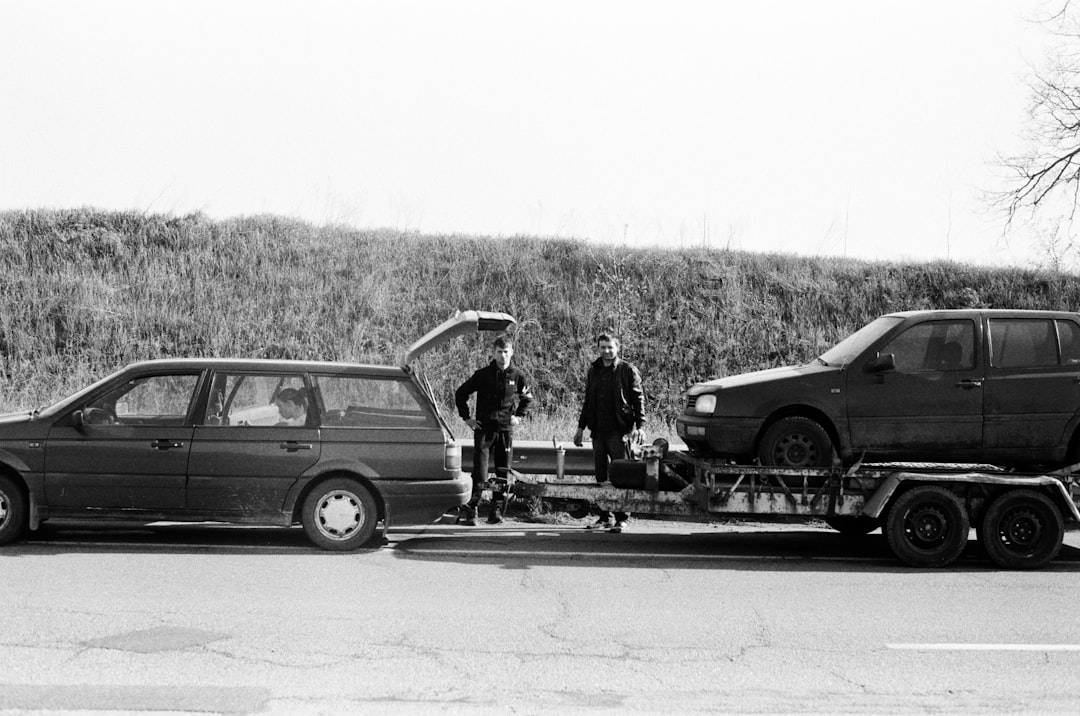 Photo by Max Ovcharenko
on Unsplash
Photo by Max Ovcharenko
on Unsplash
- Cargo limits, not liability, are the underwriting heart of an auto-hauler program. A typical 9-car open trailer carries $250,000–$500,000 of vehicles at any moment; a 6–8 car enclosed luxury trailer can carry $1,000,000–$3,000,000+. The $100,000 motor truck cargo (MTC) limit on a generic trucking program will not cover a single load.
- Standard MTC forms exclude "automobiles in transit" unless the auto-hauler endorsement is added. Without the endorsement, every load drives uninsured. Specialty auto-hauler cargo forms also commonly exclude keys-in-ignition theft, mechanical breakdown, manufacturer defect, and damage during loading by anyone other than the driver — read the form before binding.
- Federal Motor Carrier Safety Administration (FMCSA) financial responsibility under 49 CFR Part 387 requires only $750,000 primary liability for general freight 10,001+ lb GVWR, but OEM and major-auction contracts routinely demand $1,000,000–$5,000,000 auto liability, $1,000,000–$3,000,000 cargo, and $5,000,000+ umbrella with the shipper named as additional insured.
- The chargeback regime is the operating reality of auto-hauling. OEMs (Ford, GM, Stellantis, Toyota), auction networks (Manheim, ADESA), and dealer-trade work all use signed condition reports plus per-vehicle damage authority caps ($300–$3,000 per unit) that route most transit damage to the carrier's pocket rather than to a cargo claim. Cargo policy is sized to handle the catastrophic exception, not the daily friction.
- Most admitted commercial auto carriers decline auto-hauler risks. Placement runs through specialty trucking program markets (Canal Insurance, Sentry, Berkshire Hathaway GUARD, Great West Casualty for select segments) and the Excess & Surplus market (Lloyd's syndicates, AmTrust, Atlantic Specialty / Old Republic, Hudson, James River, Lexington/AIG E&S). Expect 4–6 weeks of placement time and $14,000–$45,000+ per power unit in total program cost depending on segment, fleet size, and equipment.
How auto-hauler insurance is fundamentally different from general trucking
Auto-hauler operations look like general trucking from the outside — Class 8 tractor, multi-axle trailer, interstate routes, FMCSA authority — but underwriters treat car-carriers as an entirely separate class because of three exposures that compound on each other: high cargo value concentrated on a single trailer, contractual liability terms that shift risk back to the carrier, and specialized equipment that has to be insured at stated value rather than depreciated cash value. A program that works for a dry-van carrier will not work for an auto-hauler, and pricing it that way is the most common reason an auto-hauler shows up in our office mid-year asking for a re-shop.
The first exposure is cargo concentration. A typical 9-car open hauler running OEM new-vehicle distribution out of an assembly plant or rail ramp carries $250,000–$500,000 in vehicles per load, with the average new-vehicle transaction price hovering near $48,000 in recent Cox Automotive Kelley Blue Book new-vehicle transaction price reports. A 6–8 car enclosed luxury or exotic transporter (Reliable Carriers and Intercity Lines compete in this segment) routinely carries $1,000,000–$3,000,000+ per load when an enthusiast collection or OEM press fleet is on board. A single per-load loss event — a rollover, a fire on a charging station for an electric-vehicle (EV) load, a theft of the entire trailer at a truck stop — exposes the cargo policy in full. The $100,000 MTC limit that comes standard on a generic for-hire trucking program is not in the same universe as the actual exposure.
The second exposure is the contract regime. Most auto-haulers operate under one of three contract structures: an OEM transport contract (originated by the manufacturer or routed through an asset-light logistics provider like United Road, RPM, ACERTUS, or Ready Auto Transport), an auction network contract (Manheim, ADESA, IAA, Copart, ACV Auctions for digital wholesale), or dealer-trade and retail-direct work brokered through load boards (Central Dispatch, Super Dispatch). All three contract types push risk down to the carrier in ways general freight does not — broad indemnification of the shipper, carrier-level chargeback authority for transit damage, no-fault deduction terms for late deliveries, and additional-insured-with-waiver-of-subrogation requirements that pierce the carrier's program. The cargo policy alone does not solve this. The whole program has to be priced and structured against the contract.
The third exposure is the equipment. A modern multi-level car-carrier tractor (Peterbilt 389, Kenworth W990, Western Star 4900) configured for auto-hauling typically runs $150,000–$220,000 new. The trailer matters even more: a 9-car open stinger-steer hauler (Cottrell, Boydstun, Sun Country) prices at $90,000–$160,000 new, while a 6–8 car enclosed transporter with hydraulic lift gates and climate control prices at $150,000–$300,000+. Standard "actual cash value" (ACV) physical damage settles a total loss at depreciated value, which on specialized auto-hauler equipment means the carrier eats $40,000–$120,000 in replacement-cost gap. Stated-value or agreed-value physical damage is the only credible structure. We cover physical-damage form selection in detail in the trucking insurance pillar guide; auto-haulers should treat agreed-value as non-negotiable.
How auto-hauler cargo insurance actually works
Auto-hauler cargo coverage is not the motor truck cargo (MTC) policy that comes attached to a generic trucking program — it is a specialty cargo form (or an MTC policy with a specific automobile-hauler endorsement) priced on the per-load and per-vehicle value at risk. The two questions that drive everything else are how much is on the trailer at any moment, and how the policy responds when a single car gets damaged versus when an entire load gets lost. Most coverage gaps we see in this segment come from operators who priced cargo at a generic limit instead of sizing it to the actual exposure their loads carry.
Standard MTC excludes automobiles unless the auto-hauler endorsement is added
The standard motor truck cargo policy form, in most insurer wordings, contains an exclusion for "automobiles, trucks, motorcycles, or other self-propelled vehicles being transported as cargo" unless a specific auto-hauler or vehicle-in-transit endorsement is attached. An auto-hauler operator that buys a generic for-hire trucking program online and assumes the $100,000 cargo limit covers the load is uninsured the moment the first vehicle is loaded. Confirm in writing that the policy form includes the automobile-hauler endorsement (sometimes manuscript-form on the carrier program side) before you bind, and obtain a copy of the actual form rather than only the declarations page.
Per-vehicle limits, per-trailer aggregates, and stacking
Auto-hauler cargo policies typically structure limits in three layers: a per-vehicle limit (the most the policy will pay for a single car), a per-conveyance or per-trailer aggregate (the most the policy will pay for an entire load), and a per-occurrence aggregate that resets each policy term. The most common gap is a per-vehicle limit that is too low for the actual cargo: a $50,000 per-vehicle limit on a load that includes a $90,000 luxury SUV or a $140,000 EV pickup leaves $40,000–$90,000 uninsured per unit at total loss. The per-trailer aggregate has to be sized to the realistic peak — not the average load — for the kind of work being done.
| Operator type | Typical equipment | Cargo limit recommendation | Per-vehicle limit |
|---|---|---|---|
| OEM new-vehicle distribution (mainstream brands) | 9–10 car open stinger-steer | $300,000–$500,000 per trailer | $60,000–$80,000 |
| Auction haul (Manheim, ADESA, IAA, Copart) | 9 car open stinger-steer | $250,000–$400,000 per trailer | $50,000–$75,000 |
| Dealer-trade / retail wholesale | 3–5 car wedge, single-level open | $200,000–$350,000 per trailer | $75,000–$125,000 |
| Enthusiast / classic / exotic enclosed | 6–8 car enclosed climate-controlled | $1,000,000–$3,000,000 per trailer | $250,000–$1,000,000+ |
| EV-heavy fleet distribution | 9 car open with EV-rated tie-downs | $500,000–$800,000 per trailer | $80,000–$150,000 |
Common cargo exclusions auto-haulers miss when they read the form
Even with the auto-hauler endorsement attached, specialty cargo forms commonly exclude or sublimit several specific scenarios. These are not edge cases — they are the most common claim disputes in the segment:
- Keys-in-ignition theft: Many cargo forms exclude theft of a vehicle while keys are in the ignition or in the cab. Auto-haulers routinely leave keys in the cab during loading and at staging yards. The exclusion turns a $48,000 stolen-vehicle loss into an uninsured deduction. Look for a "keys-attended" or "secure storage" definition that matches how loading actually happens, or negotiate the exclusion off.
- Mechanical breakdown and battery discharge: Standard cargo forms exclude loss caused by mechanical breakdown, electrical failure, or battery discharge during transit. EV transport has made this exclusion painful — a Tesla, Rivian, or Ford F-150 Lightning that arrives with a depleted battery and a thermal-management fault can be charged back as transit damage even though no impact occurred. Ask whether the form excludes "damage to batteries from depletion or charging-system events" specifically.
- Loading/unloading damage when loaded by anyone other than the driver: If the OEM plant uses its own driveaway crew to load the trailer, or if an auction yard hostler positions vehicles, some cargo forms exclude damage during loading because the carrier's driver did not have control. This is a contract-coordination problem — match the cargo form to who actually touches the cars.
- Damage to glass, paint, and trim within stated tolerances: OEM and auction contracts have explicit "transit acceptable damage" tolerances (paint chips smaller than a quarter, scratch length under a defined inch threshold). Cargo forms typically follow this — minor cosmetic damage is the carrier's problem, not the cargo policy's. The cargo policy responds to total losses, large-deductible singular damage, and load-level catastrophes, not the friction.
- Manufacturer defects discovered post-delivery: A vehicle that arrives with a defect later traced to the assembly plant is not a cargo claim. The OEM's quality system handles it — and disputes about whether damage is transit-caused or factory-caused are resolved at the receiving line, not at the cargo carrier's adjuster. Document condition at pickup with timestamped photos to defend the boundary.
- Theft of cargo from an unattended trailer at a truck stop: Some cargo forms reduce coverage to a sublimit (often $25,000–$100,000) when the trailer is unattended overnight at non-secured locations. The full cargo limit applies only when the trailer is at a fenced/lighted secured yard. Plan routes accordingly or accept the sublimit.
Stated-value physical damage on the rig and contract-driven liability limits
After cargo, the next two highest-impact decisions on an auto-hauler program are the physical damage form on the tractor and trailer (always agreed-value or stated-value, never actual cash value) and the liability limits, which are almost never set by the FMCSA minimum and almost always set by the contract with the OEM, auction, or shipper. Getting either one wrong costs the carrier real money on a single event and quietly costs them margin on every load until renewal.
Agreed-value vs. stated-value vs. actual cash value
Standard physical damage in commercial auto policies pays actual cash value (ACV) at total loss — the depreciated market value of the unit at the moment of loss. On a generic Class 8 dry-van tractor, the gap between ACV and replacement is usually manageable. On an auto-hauler tractor with $40,000 in specialized equipment (PTO, hydraulics for the trailer, custom fifth-wheel mounting) and a stinger-steer trailer that has no real used market because it was custom-spec'd, ACV creates a $40,000–$120,000 replacement gap on a single total loss. The two alternatives both fix this, with different mechanics:
- Stated value: The insured declares a value at policy inception, and the policy pays the lesser of ACV, stated value, or repair cost at total loss. Stated value caps the upside (the policy will not pay more than the declared number) but does not guarantee payment of the full declared number — ACV still applies if it is lower. This is a partial fix and a common source of post-loss surprise.
- Agreed value: The insured and insurer agree at inception on the total-loss settlement value, supported by appraisal or detailed equipment list, and the policy pays that exact amount at total loss without regard to ACV. Agreed value is the credible structure for auto-hauler equipment. It costs 5–15% more in premium than ACV and eliminates the depreciation argument at claim time.
- What to ask for: Request agreed value with annual revaluation, and update the equipment schedule whenever the trailer is re-decked, the tractor's PTO/hydraulics are rebuilt, or a major component is replaced. Carry a written equipment inventory with serial numbers and photographs as part of the underwriting submission.
Liability is set by the contract, not the FMCSA minimum
The federal floor for auto-hauler liability under 49 CFR Part 387 is the same $750,000 primary limit that applies to general freight 10,001+ lb GVWR, and the carrier files a BMC-91 or BMC-91X with FMCSA at that level to secure operating authority. In practice, no major shipper accepts a $750,000 policy. OEM transport contracts (United Road, RPM, ACERTUS, Ready Auto Transport, and OEM-direct programs) typically require $1,000,000 combined single limit (CSL) primary auto liability with $5,000,000 umbrella attached, additional insured status, and waiver of subrogation. Major auction networks (Manheim, ADESA, IAA) are similar — $1,000,000 primary, $2,000,000–$5,000,000 umbrella, additional insured. Enthusiast/exotic transporters often carry $2,000,000–$5,000,000 primary CSL and $5,000,000–$10,000,000 umbrella because a single nuclear verdict in a high-value collision is the existential risk.
The American Transportation Research Institute reported in its 2020 study Understanding the Impact of Nuclear Verdicts on the Trucking Industry that verdict award sizes grew roughly 51.7% per year from 2010 to 2018 — against 1.7% general inflation — with the average verdict in the dataset rising from $2.31 million in 2010 to $22.3 million in 2018. That number is for general trucking, not specifically auto-hauling, but it sets the umbrella conversation for any motor carrier with passenger-vehicle exposure. We cover the nuclear-verdict mechanics and umbrella sizing in detail in the trucking claims guide; on the auto-hauler side, the practical floor for umbrella is $5,000,000 if the operation crosses state lines and $10,000,000 if any contract requires it or if the carrier runs through dense metropolitan corridors at peak commute times.
Trailer interchange and non-owned trailer coverage
Auto-haulers running for OEM logistics providers or auction networks frequently move trailers they do not own — picking up a loaded rail-ramp trailer that belongs to the OEM, hooking to a Manheim-owned trailer for a yard move, or interchanging trailers with another carrier mid-route. Standard physical damage on the carrier's owned tractor does not cover damage to a trailer the carrier does not own. Trailer interchange coverage (sometimes called non-owned trailer physical damage) responds to physical damage to a trailer in the carrier's possession under a written interchange agreement. Limits typically run $25,000–$150,000 per trailer; auto-haulers with frequent interchange should size this to the most expensive trailer they ever pull. Premium runs $400–$1,500 per power unit per year for the typical limit range. Confirm the interchange agreement is in writing — the coverage requires it.
Contract chargebacks, condition reports, and how transit damage actually gets resolved
The chargeback regime is the operating reality of auto-hauling and the single feature of the segment that surprises new entrants the most. OEMs, auction operators, and dealer-trade brokers all use signed condition reports plus per-vehicle damage authority caps to route most transit damage to the carrier's pocket rather than to a cargo insurance claim. Operators who price cargo coverage and ignore chargebacks find themselves margin-negative on otherwise profitable lanes within the first 90 days of a contract. Cargo policy is sized to handle the catastrophic exception; the chargeback budget handles the daily friction.
Condition reports and the moment of risk transfer
A condition report (sometimes called a Bill of Lading exception report, or in OEM environments a "driveaway" or "carrier acceptance" form) documents the cosmetic and mechanical state of every vehicle at the moment the carrier accepts custody. The driver walks the unit, marks any pre-existing damage on the report, and signs. From that moment, any new damage on that vehicle is presumed to have occurred in the carrier's custody — the burden is on the carrier to disprove it, not on the receiver to prove it. Drivers who skip the walk-around or sign blank condition reports surrender every transit-damage dispute before it starts. This is enforced by every major shipper in the segment.
Damage authority caps — how chargebacks bypass the cargo policy
OEM, auction, and large-fleet dealer contracts give the receiver damage authority — the right to deduct a defined dollar amount per damaged unit from the carrier's invoice without filing a cargo claim. Typical caps run $300–$3,000 per vehicle for cosmetic damage (scratches, paint chips, minor dents under defined size thresholds). This is intentional contract design — the receiver does not want to file a $400 cargo claim with a $1,000 deductible policy any more than the carrier wants to defend it. The chargeback bypasses insurance entirely. Practically:
- Damage under the chargeback cap: Deducted from the carrier's invoice, no insurance claim opens, no loss-run entry. The carrier eats the cost out of margin. Typical operator budget: $30–$120 per vehicle delivered as a chargeback reserve, depending on segment and route hardness.
- Damage over the chargeback cap: Routes to a cargo claim with the carrier's insurer. The deductible (typically $1,000–$5,000 per occurrence) and the per-vehicle cargo limit determine net recovery. The carrier still owes the receiver the chargeback cap as the de facto deductible bottom.
- Total loss or major event: Cargo policy responds at full per-vehicle and per-trailer limits, less the deductible and any contract-imposed self-insurance retention. This is the catastrophic exposure the cargo limit is sized for.
- Late delivery deductions: Many OEM contracts impose per-day late deductions that are not transit damage and not insurable. These are pure operating risk — late-delivery exposure has to be priced into the rate, not transferred to the carrier's cargo policy.
Subrogation and the cargo-vs-liability boundary
When a third party is responsible for transit damage (a parking lot operator, a fueling station, a shipper's loader who damaged a vehicle at pickup), the cargo carrier pays the claim and then subrogates against the responsible party. Auto-hauler programs should require the cargo carrier to retain subrogation rights (avoid blanket waivers in contracts that block recovery), and the operator should preserve evidence at pickup and delivery — timestamped photos, GPS-stamped condition reports, dashcam footage of loading, recorded gate-in/gate-out times. Carriers that document well recover 30–60% of their subrogation-eligible cargo losses; carriers that do not document recover almost none.
The cargo-vs-liability boundary matters most when a load incident causes both vehicle damage and third-party bodily injury or property damage — for example, a rollover that destroys the load, damages a guardrail, and injures a passing motorist. Cargo carrier handles the vehicles on the trailer. Auto liability carrier handles the third-party injury and the guardrail. Workers' comp handles the driver. These are three separate policies, three separate claim files, and three separate adjusters, often from three different insurance companies, all of which have to coordinate. A specialist trucking broker is the connective tissue. We cover the four-policy claims sequence in the commercial trucking insurance claims guide in the context of general freight; auto-hauling adds the chargeback layer on top of that sequence.
Where auto-hauler programs actually get placed — and what falls through
Auto-hauler placement is a specialty broker function, not a generic commercial-auto exercise. Most admitted standard markets decline car-carrier risks outright because the cargo concentration, equipment specialization, and contract-driven liability requirements fall outside their underwriting boxes. Placement runs through specialty trucking program markets and the Excess & Surplus (E&S) market, with broker access, submission quality, and operational discipline determining whether the account places at all and at what price. We cover the broader trucking carrier-market structure in the commercial trucking insurance market guide; the auto-hauler segment narrows that map to a handful of credible markets.
Where auto-hauler programs actually place
- Specialty trucking program markets: Canal Insurance (long-time auto-hauler appetite), Sentry Insurance, Berkshire Hathaway GUARD, Great West Casualty (select segments only — typically the OEM/auction side, not enthusiast/exotic), Northland (Travelers commercial transportation), Cherokee Insurance, and Protective Insurance Group write a meaningful share of the auto-hauler market with admitted paper. These markets handle clean-loss-history, established operators with 5+ years of in-class experience.
- E&S specialty markets: Lloyd's of London syndicates (writing through specialty wholesalers like RT Specialty, Amwins, CRC), Atlantic Specialty / Old Republic, AmTrust Specialty, Hudson Insurance, James River Insurance, Lexington/AIG E&S, Markel Specialty, and Scottsdale/Nationwide E&S handle new-authority operators, troubled loss history, exotic enclosed transport, and any account a standard market declined. Premium runs 25–60% higher than admitted equivalents, but coverage is broader and form negotiability is higher.
- OEM-side captives and contract-arranged programs: United Road, RPM, ACERTUS, and Ready Auto Transport sometimes run captive insurance arrangements or master programs that subcontracted carriers participate in. These are contract-by-contract; do not assume one captive's terms apply to a different contract.
- What does not write auto-hauler: Most admitted Progressive Commercial, Northland generic dry-van programs, GEICO Commercial, and direct-quote online trucking programs decline car-carrier risks at first underwriting question. Operators trying to bind through these channels are either declined at submission or written on a generic form that excludes the cargo. Both outcomes are bad.
The six coverage gaps we see most often in auto-hauler audits
- Cargo limit sized to average load instead of peak load. Operator carries $250,000 cargo because that's the average load value, but runs occasional $500,000+ peak loads (year-end inventory pushes, exotic transport, OEM press fleets). One peak-load total loss exposes $250,000+. Fix: size cargo to realistic peak, not average.
- Per-vehicle limit too low for actual unit values. Operator carries $50,000 per-vehicle limit but routinely hauls $80,000–$140,000 luxury SUVs and EV pickups. Each total-loss event leaves $30,000–$90,000 uninsured. Fix: review the per-vehicle limit against the realistic top-end unit on the lane.
- Standard MTC without the auto-hauler endorsement. Operator bought a generic for-hire trucking program, never confirmed the cargo form covers automobiles. Every load drives uninsured. Fix: confirm in writing the policy form includes the automobile-hauler endorsement (and obtain a copy of the form, not just the declarations page).
- ACV physical damage on the rig instead of agreed value. Operator's $180,000 stinger-steer rig totals at $95,000 ACV after three years of depreciation. Replacement gap of $85,000 lands on the operator. Fix: agreed value with annual revaluation and equipment schedule.
- No trailer interchange when the operation runs OEM- or auction-owned trailers. Damage to a non-owned trailer in carrier custody is an open exposure. Fix: trailer interchange at a limit sized to the most expensive interchanged trailer, with the written interchange agreement on file.
- Liability limits set to the FMCSA minimum on a contract that requires more. Operator files BMC-91 at $750,000 because that's the legal minimum, takes an OEM contract that requires $1,000,000 with $5,000,000 umbrella and additional insured. Operator is in breach from day one and discovers it only when the shipper requests an updated certificate of insurance (COI). Fix: read the contract's insurance requirements before quoting the lane, and price the program to the contract.
The 9-car operator whose generic trucking program excluded the cargo
A four-truck stinger-steer auto-hauler operator running OEM-tier dealer-distribution work out of an upper Midwest rail ramp came to us at renewal after their incumbent broker had placed them on a generic for-hire trucking program with a $100,000 motor truck cargo (MTC) limit. Average load value across their lanes ran $310,000, with peak loads — year-end inventory and seasonal SUV pushes — clearing $480,000. Two months before renewal, they had a single-vehicle rollover at highway speed on a state route in Ohio. The trailer carried six vehicles totaling $336,000 cargo value at the moment of loss. The driver was uninjured; auto liability paid the third-party guardrail damage and a minor injury claim. Cargo, however, came back denied — the policy form was a standard MTC wording that excluded automobiles in transit, and no auto-hauler endorsement had been added at inception. The operator absorbed the $336,000 cargo loss net of a $0 recovery, plus three months of OEM contract suspension while they re-shopped insurance.
We restructured the program through a specialty trucking program market with a true auto-hauler cargo form: $500,000 per-trailer aggregate cargo limit, $80,000 per-vehicle limit, agreed-value physical damage on all four tractors and trailers (re-appraised against an equipment schedule we pulled together with the operator's mechanic), $1,000,000 primary auto liability with $5,000,000 umbrella to match the OEM-tier contract requirements, and trailer interchange at $100,000 to cover the rail-ramp loaded trailers they were picking up. Annual program premium increased from $94,000 (the generic program) to $138,000 (the specialty program) — a $44,000 increase that closed five active gaps. Within seven months they had a second incident — a parking-lot collision at an auction yard that damaged three vehicles totaling $112,000 — that paid cleanly through cargo, with subrogation initiated against the auction yard's parking contractor. The total recovery from the new program in its first year exceeded the lifetime savings the prior broker had quoted as the reason to stay on the generic program.
Details anonymized and generalized to protect client confidentiality.
Frequently asked questions about auto-hauler insurance
No. Most standard motor truck cargo (MTC) policy forms exclude automobiles, trucks, motorcycles, and other self-propelled vehicles being transported as cargo unless a specific auto-hauler endorsement or vehicle-in-transit endorsement is added. An auto-hauler operating on a generic trucking program without the endorsement has no cargo coverage on any vehicle on the trailer.
Confirm the cargo form includes the auto-hauler endorsement before binding, and obtain a copy of the actual form — not just the declarations page. Specialty trucking program markets and Excess & Surplus carriers write purpose-built auto-hauler cargo forms that handle this correctly from inception.
Cargo limits should be sized to the realistic peak load value, not the average. A 9-car open hauler running OEM new-vehicle distribution typically needs $300,000–$500,000 per-trailer aggregate with $60,000–$80,000 per-vehicle. A 6–8 car enclosed luxury or exotic transporter often needs $1,000,000–$3,000,000+ per-trailer with $250,000–$1,000,000+ per-vehicle.
Run the math on the highest-value load the operation realistically picks up — year-end OEM inventory, seasonal pushes, special enthusiast events — not the trailing-12-month average. One peak-load total loss exposes the gap.
Agreed value pays the exact total-loss settlement amount agreed to at policy inception, regardless of actual cash value (ACV) at the time of loss. Stated value pays the lesser of ACV, stated value, or repair cost — so depreciation can still reduce the settlement. For specialized auto-hauler equipment with thin used markets, agreed value is the only structure that eliminates the ACV depreciation gap.
Agreed value typically costs 5–15% more in premium than ACV. Update the equipment schedule annually and after any major equipment refurbishment to keep the agreed value current.
Almost never in practice. Federal Motor Carrier Safety Administration financial responsibility rules under 49 CFR Part 387 set the legal floor at $750,000 for general freight, and auto-hauling falls under that baseline. But OEM, auction, and major-shipper contracts routinely require $1,000,000 primary combined single limit (CSL) with $5,000,000 umbrella, additional insured status, and waiver of subrogation — none of which the FMCSA minimum satisfies.
The contract sets the practical floor. Read the insurance requirements section of every shipper contract before quoting the lane, and size primary liability and umbrella to whichever contract has the highest requirement on the operating book.
Three reasons compound: cargo value concentration on a single trailer is far higher than general freight, equipment is specialized and hard to depreciate or claim against, and contractual liability terms (additional insured, waiver of subrogation, broad indemnification) push more risk onto the carrier's program than standard markets are comfortable underwriting. Most admitted carriers' auto-hauler appetite is either zero or limited to large fleets with multi-decade clean loss history.
Placement runs through specialty trucking program markets (Canal, Sentry, Berkshire Hathaway GUARD, Great West for select segments, Cherokee, Protective) and the Excess & Surplus market (Lloyd's syndicates, AmTrust, Atlantic Specialty/Old Republic, Hudson, James River, Lexington/AIG E&S, Markel Specialty). Working with a broker who actually places auto-hauler business is the single biggest determinant of whether the account places and at what price.
The chargeback regime is the contract structure used by OEMs (Ford, GM, Stellantis, Toyota), auction networks (Manheim, ADESA, IAA, Copart), and dealer-trade brokers to deduct minor transit damage from the carrier's invoice without filing a cargo insurance claim. Per-vehicle damage authority caps typically run $300–$3,000 — anything under the cap is deducted from invoice; anything over the cap routes to a cargo claim.
The practical effect is that cargo insurance handles catastrophic losses and large per-unit damage, while the chargeback budget (typically $30–$120 per vehicle delivered, depending on segment and route) handles daily friction. Operators who price cargo coverage and ignore chargebacks can end up margin-negative on otherwise profitable lanes.
Yes — fundamentally. A 6–8 car enclosed transporter routinely carries $1,000,000–$3,000,000+ per load (collector cars, exotics, OEM press fleets, motorsports transporters, manufacturer prototypes), with per-vehicle values running $250,000 to over $1,000,000 each. Cargo limits, per-vehicle limits, and physical damage on the trailer all step up by an order of magnitude versus open auto-hauling.
Enclosed transporters also require specific protections most open programs don't address: damage during loading (closed trailers use ramps with tighter clearances), climate-control system failure on long hauls, and theft from secured-but-unattended enclosed trailers. Markets like Hagerty, Heacock Classic, Grundy Worldwide, and several Lloyd's syndicates specialize in this segment.
A single-truck OEM/auction-segment auto-hauler with clean Compliance, Safety, Accountability (CSA) history and 3+ years of in-class experience typically runs $14,000–$25,000 per power unit per year for a full program — primary liability, physical damage with agreed value, motor truck cargo with auto-hauler endorsement at appropriate per-trailer and per-vehicle limits, GL, workers' comp where applicable, umbrella, and trailer interchange. Multi-truck operators see 8–15% per-truck reductions through fleet pricing.
New authority operators pay 25–50% more in the first 24 months because CSA history is empty. Enclosed enthusiast/exotic transporters run $25,000–$45,000+ per power unit because cargo limits are dramatically higher. We cover the cost mechanics of trucking insurance broadly in the 2026 trucking insurance cost guide; auto-hauling adds the cargo-driven premium step on top.
Not sure whether your current cargo limit and rig physical damage are sized to your real exposure?
Tell our AI assistant about your operation — open vs. enclosed, OEM/auction/dealer segment, fleet size, average and peak load values — and we'll outline the structural questions to put to your current broker before renewal.
Have us re-shop your auto-hauler program against the contract you actually run.
Send us your current declarations, your largest shipper contract, and a sample condition report. We'll tell you within a week whether your cargo, physical damage, liability, and umbrella line up with the work — and where the gaps are.